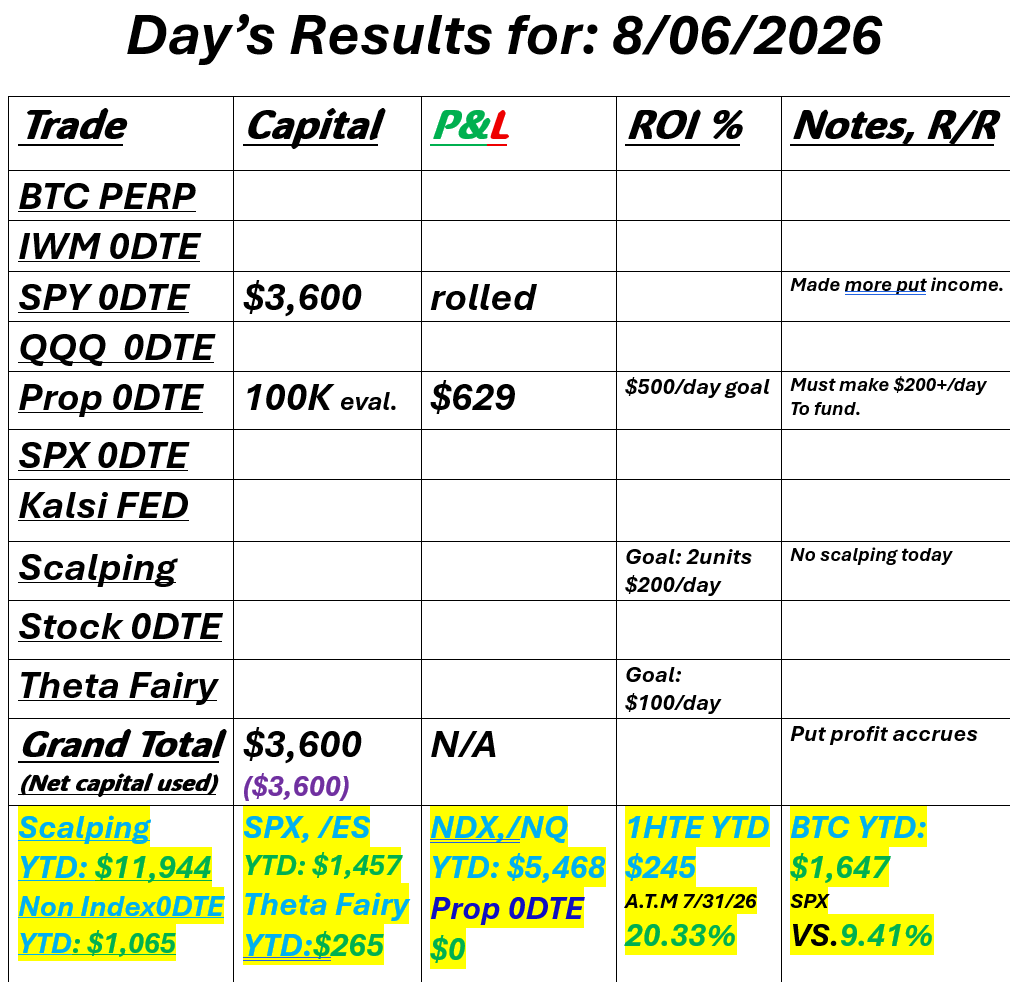
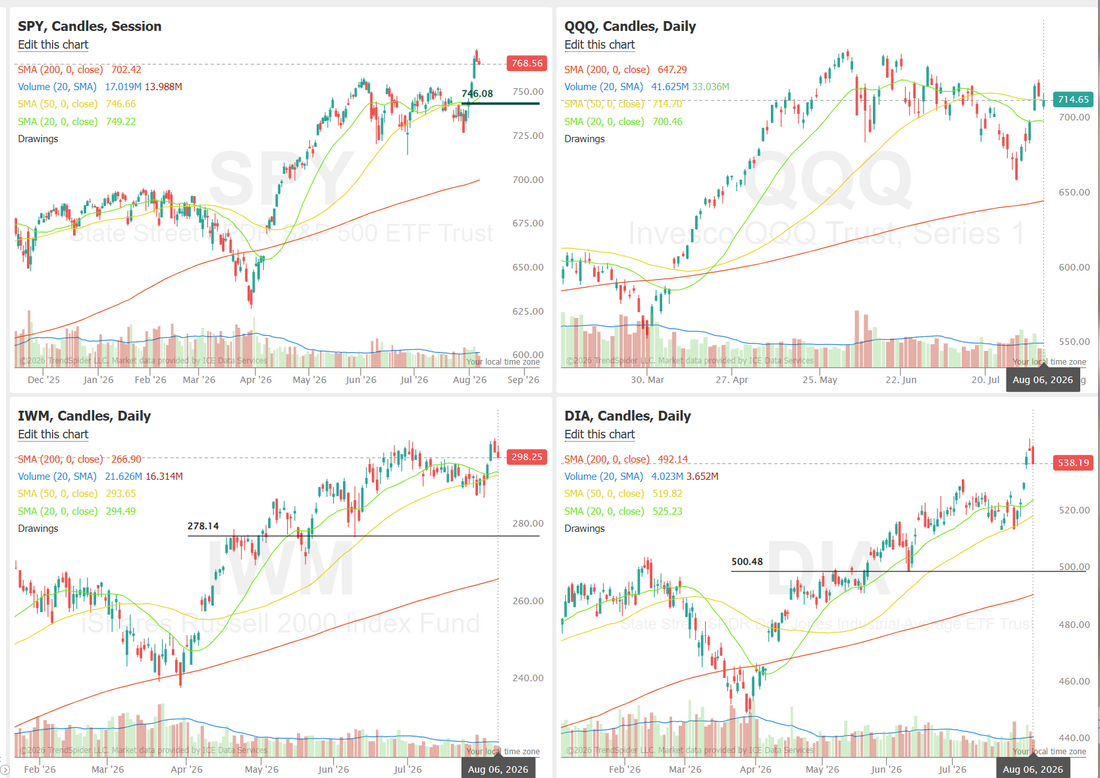
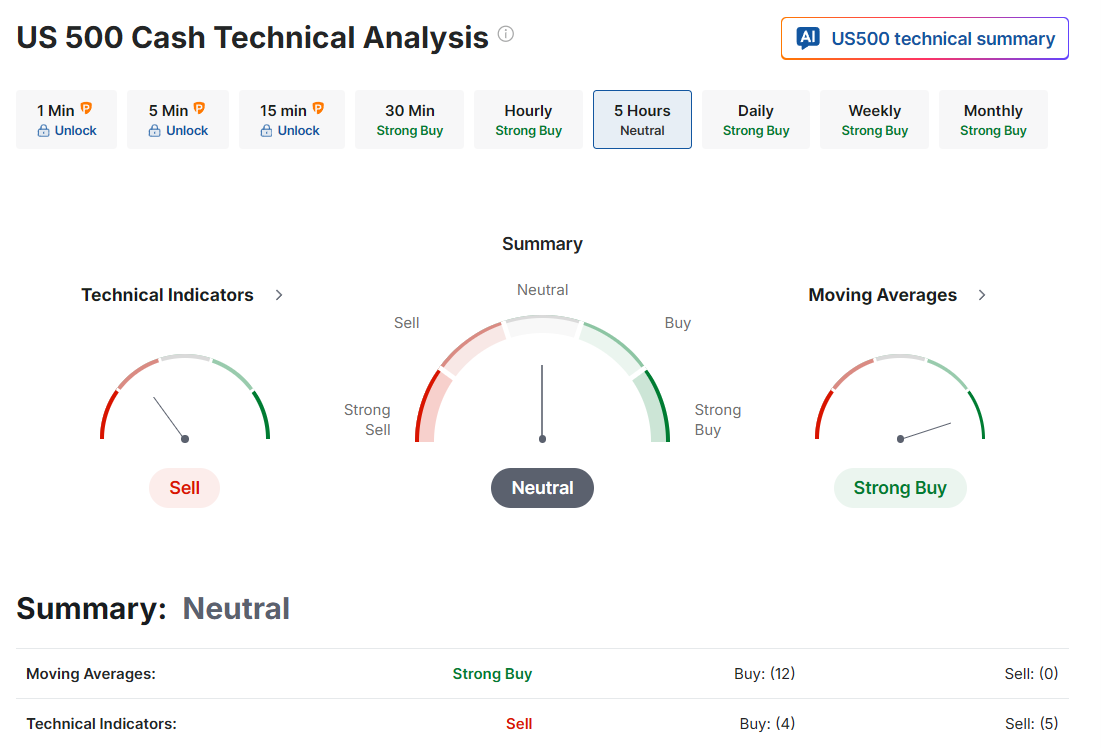
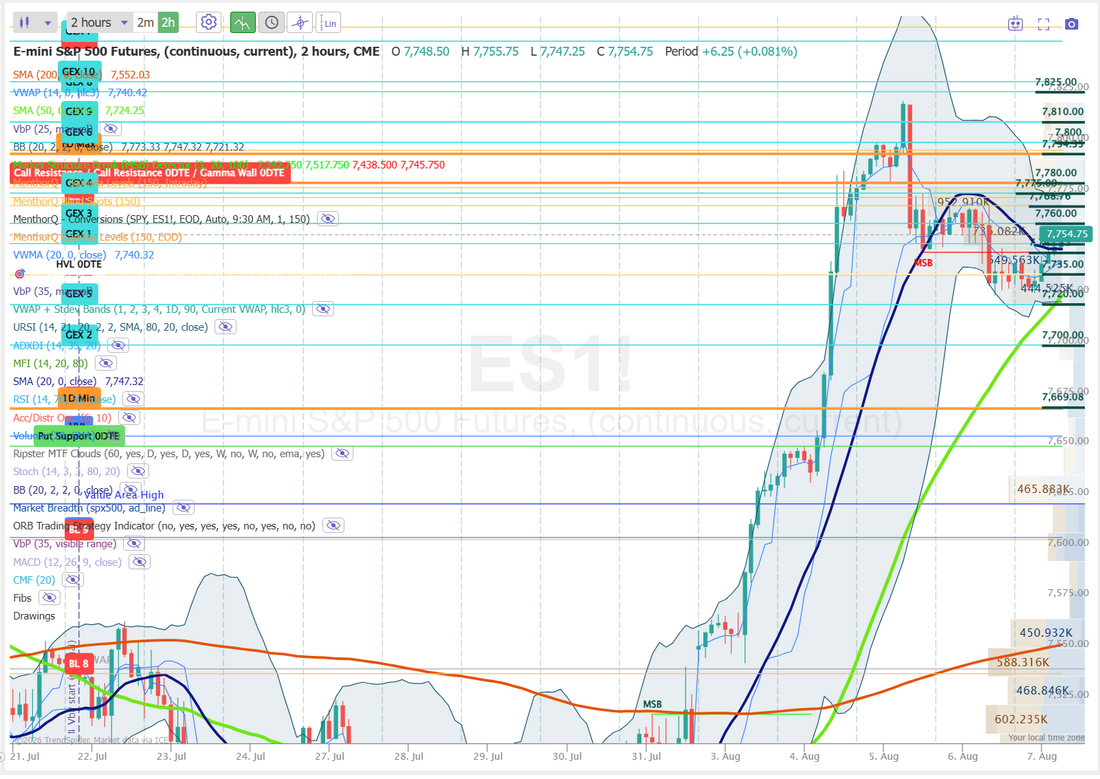
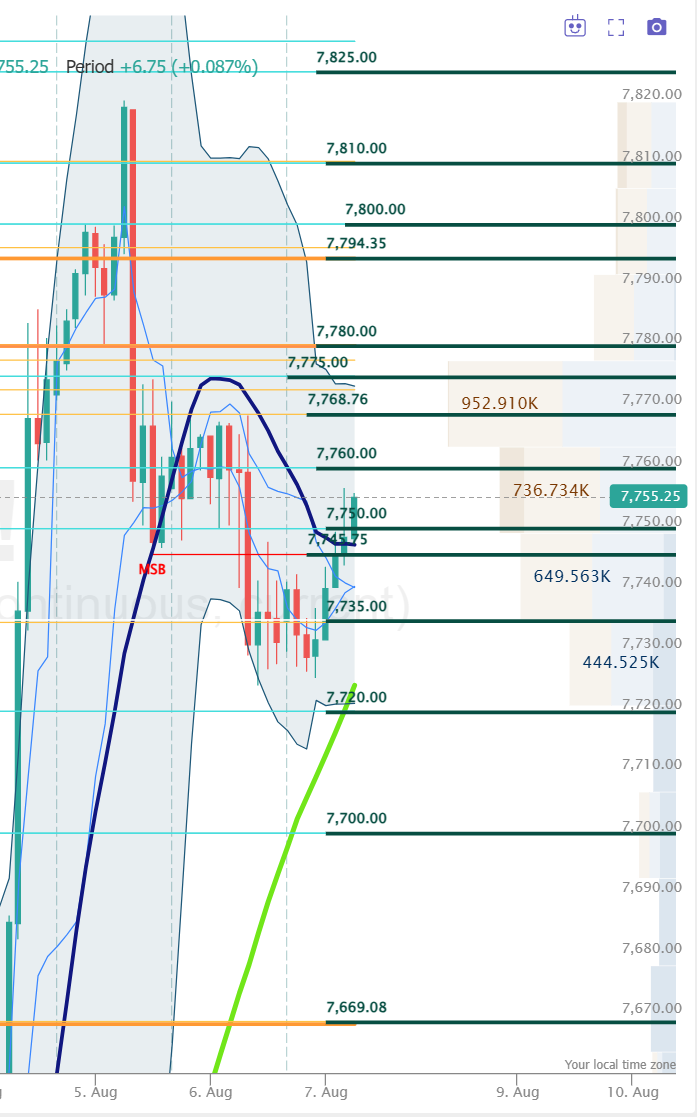
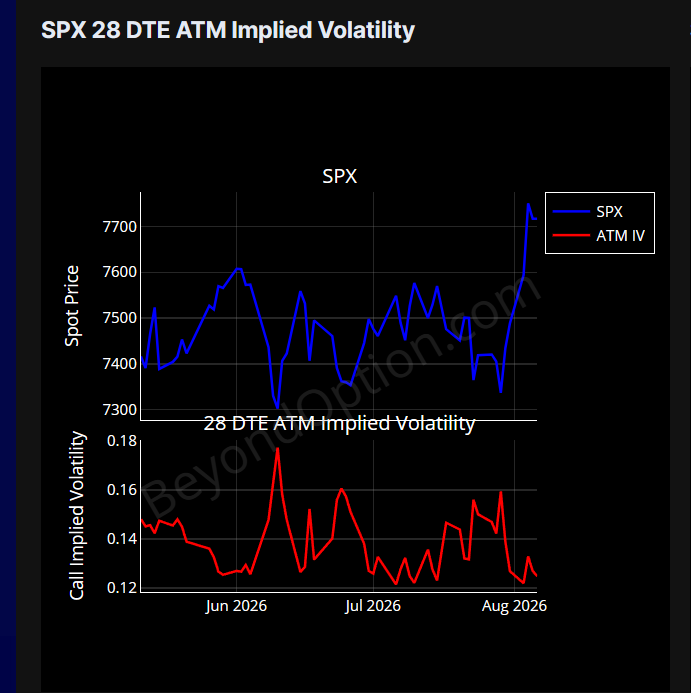
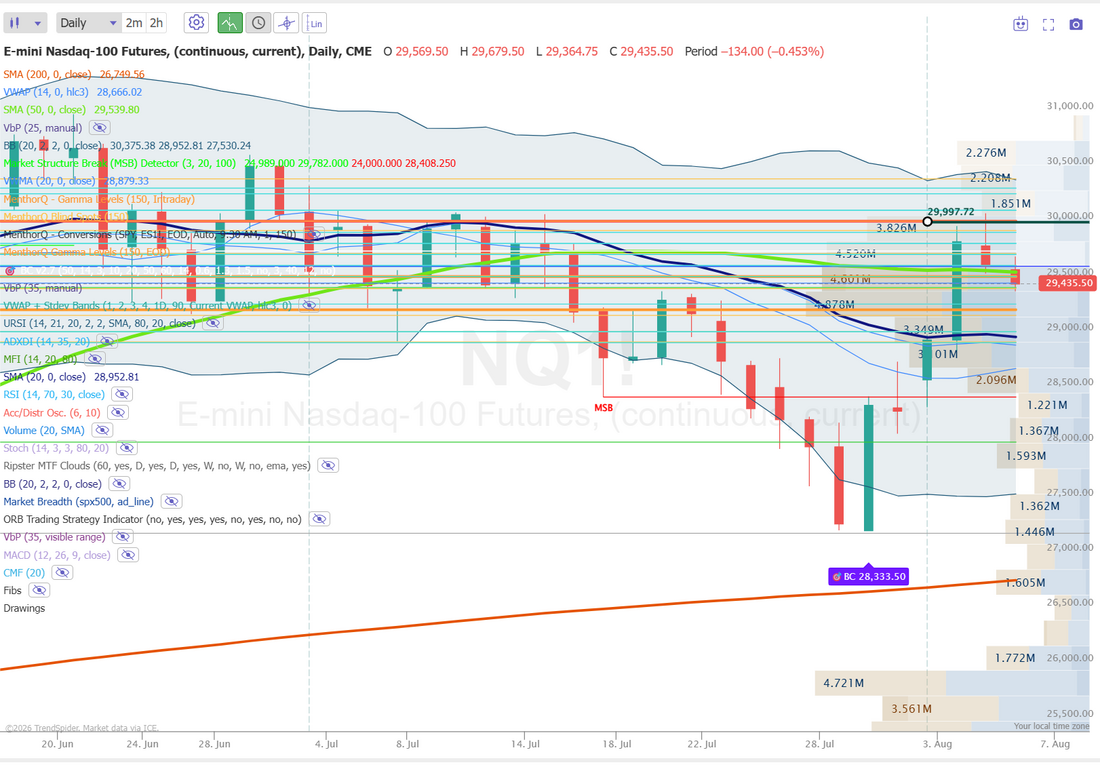
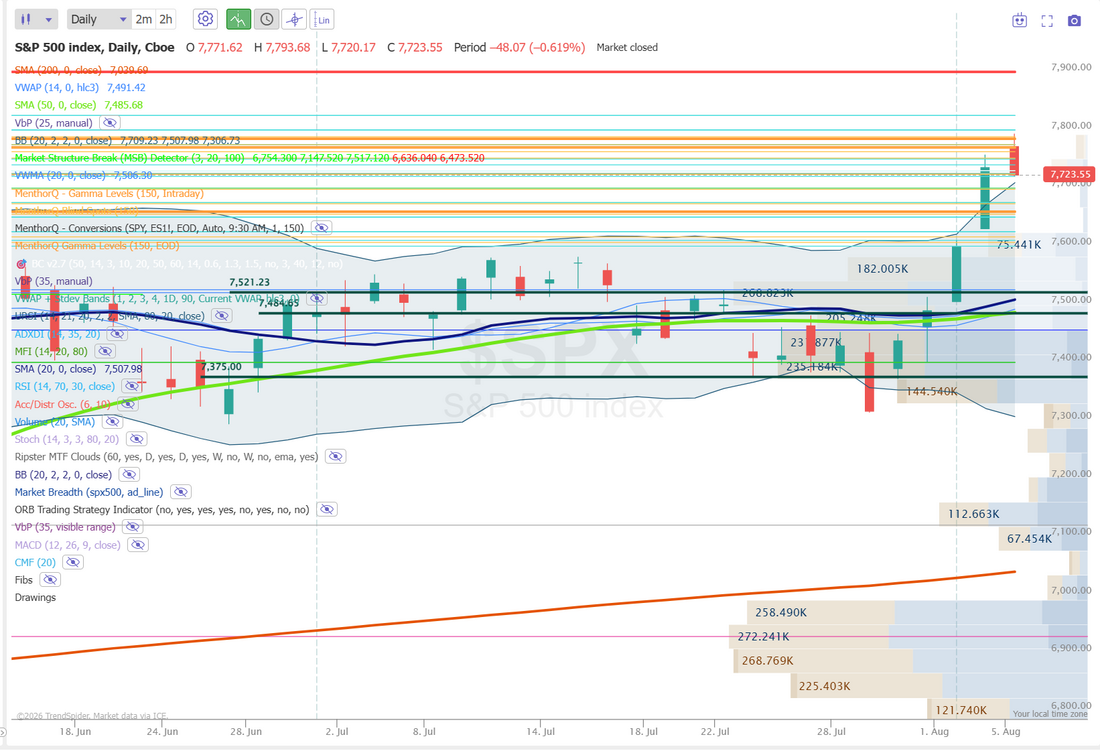
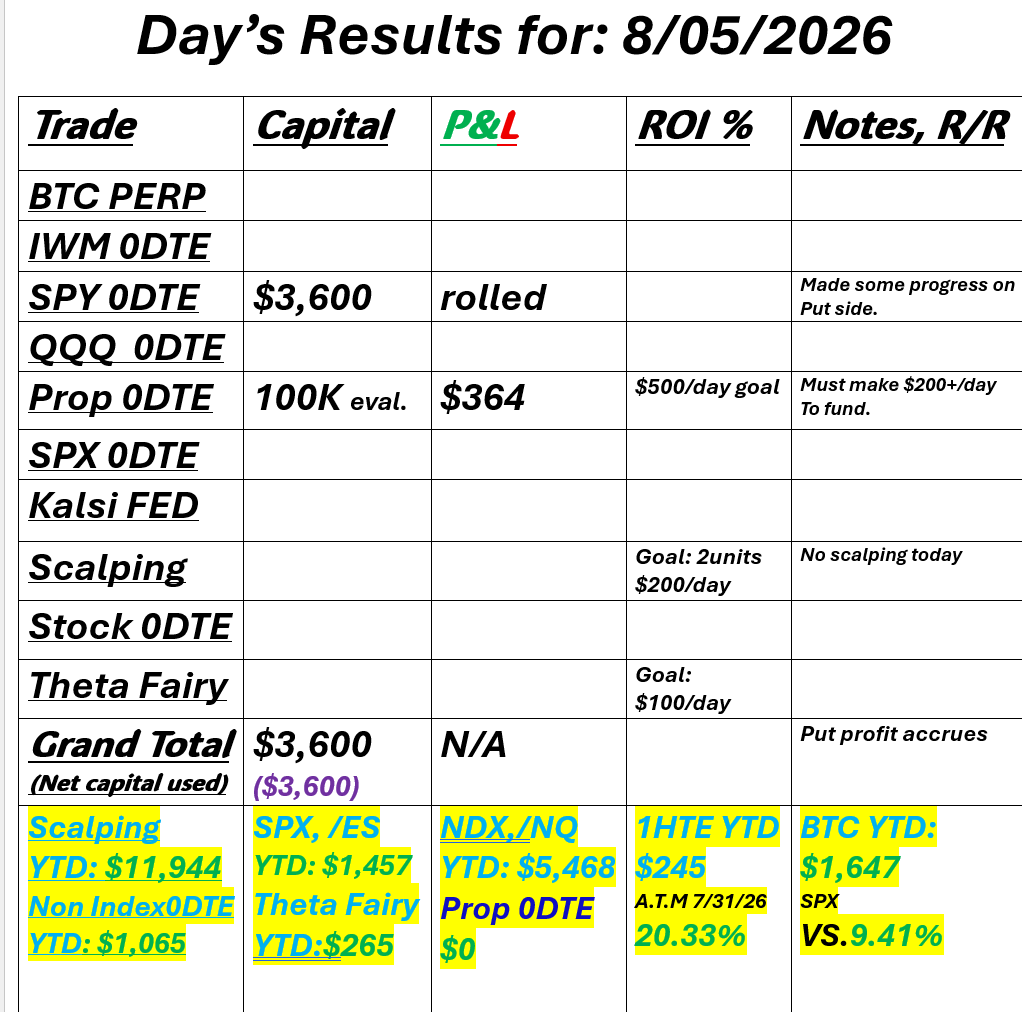
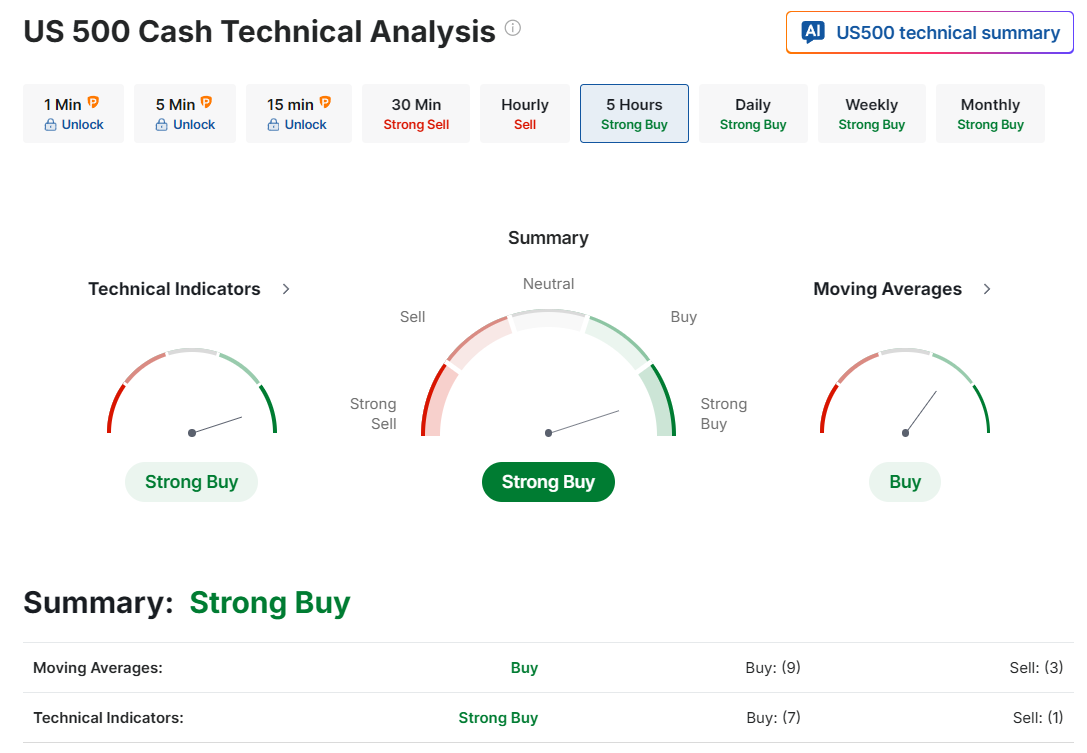
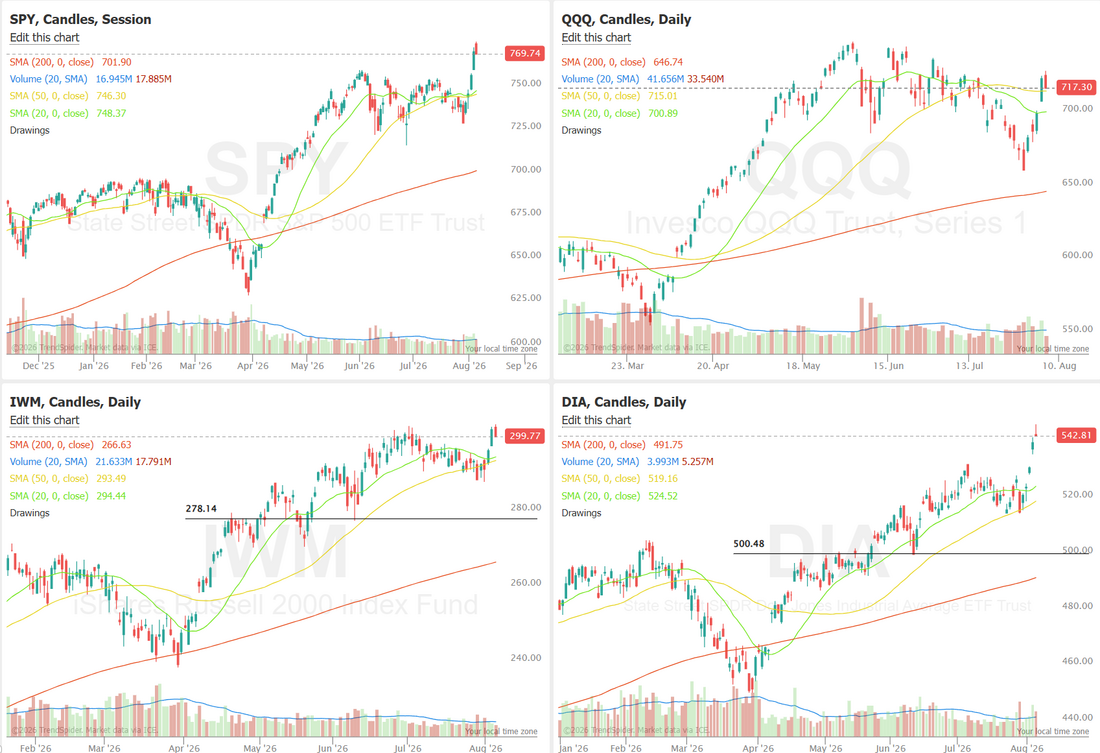
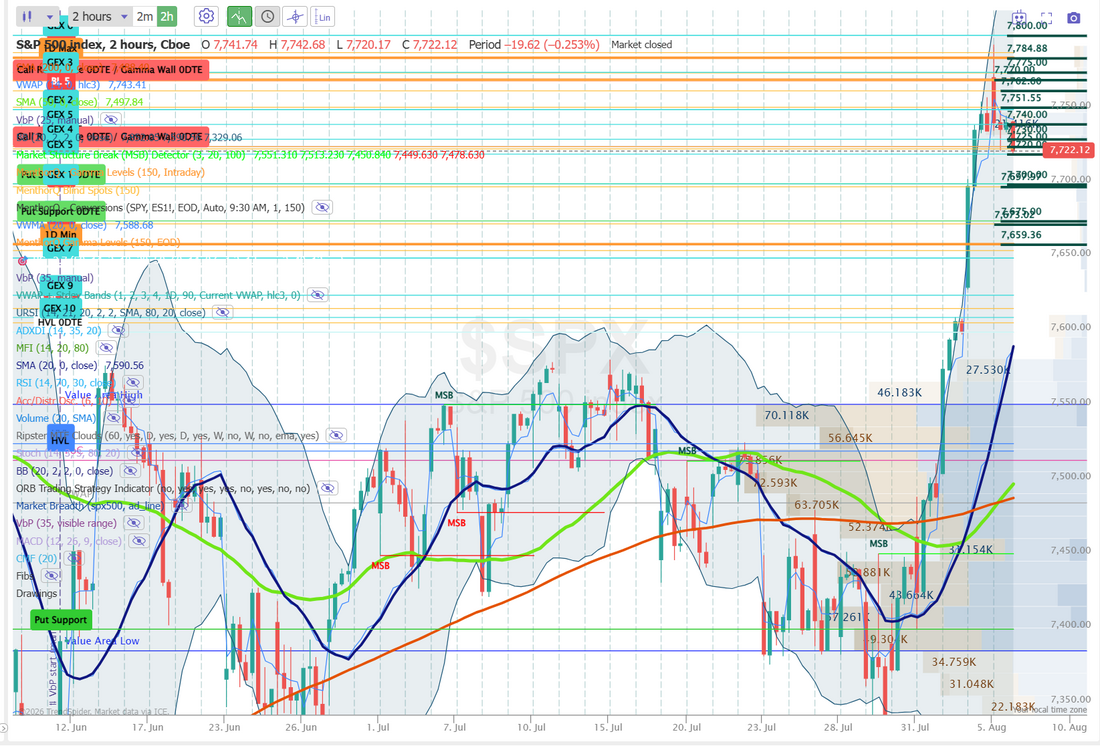
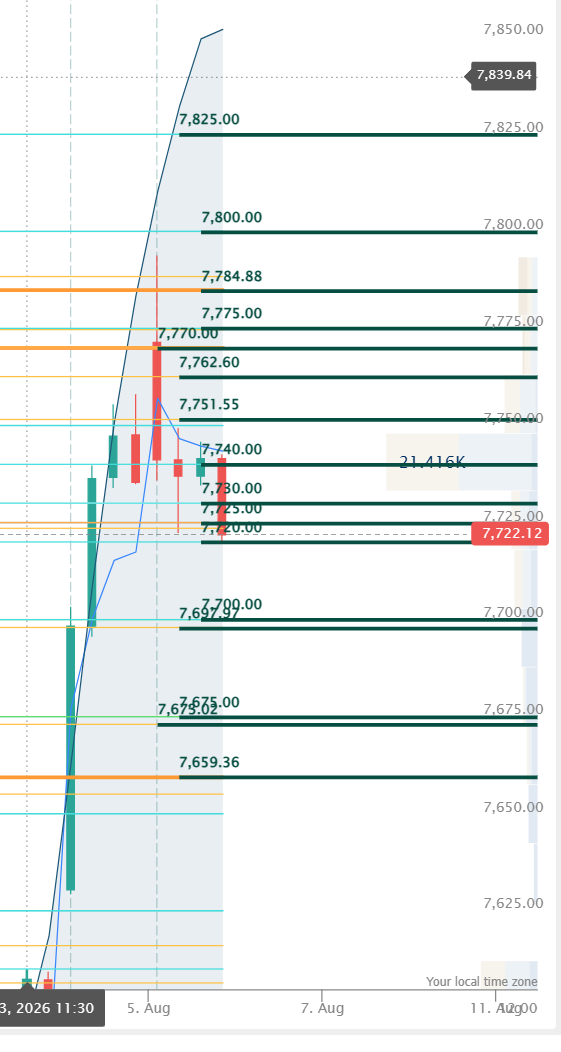
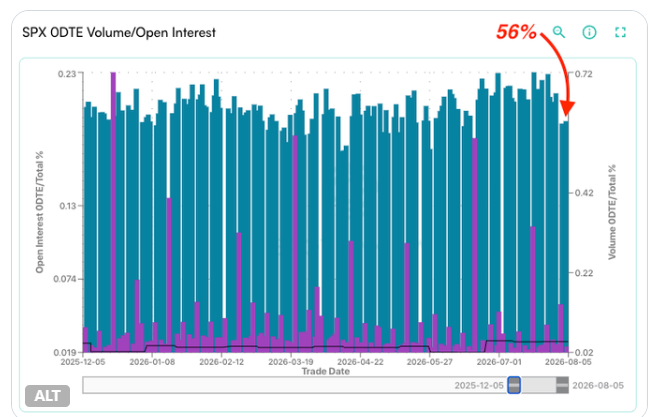
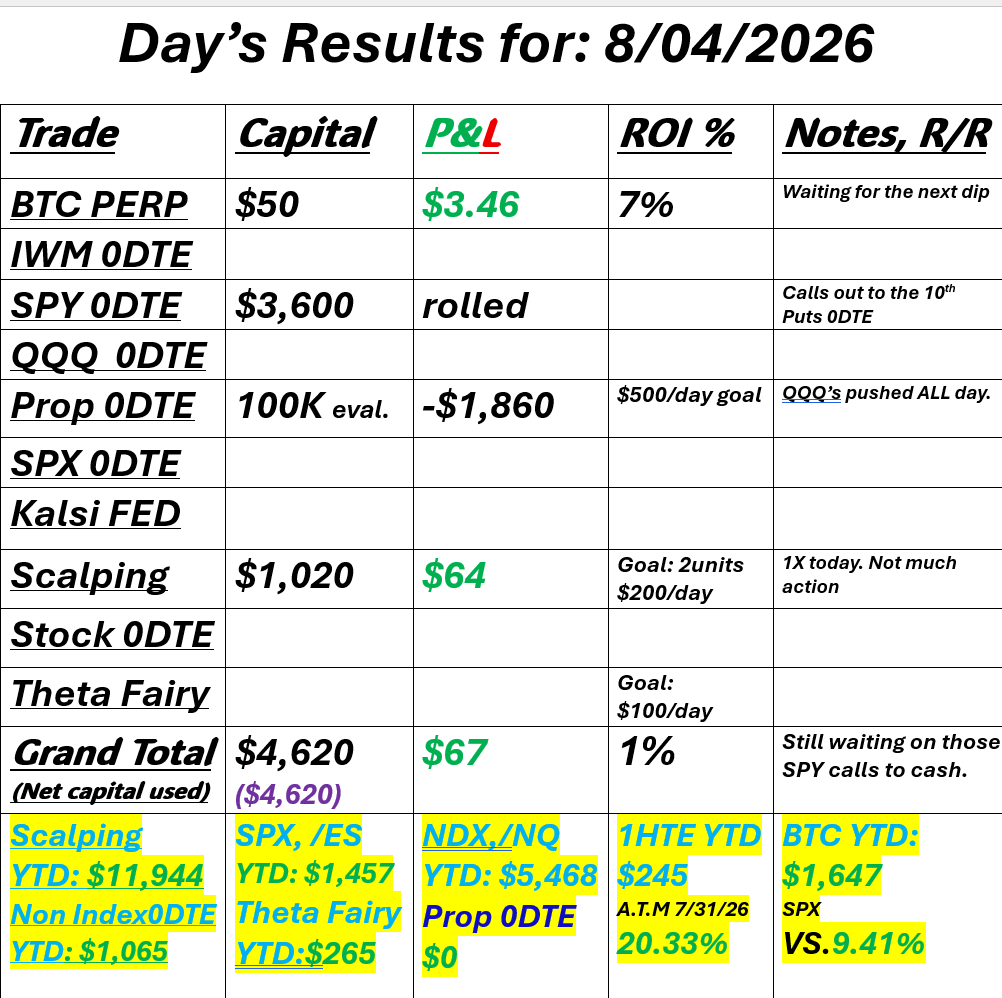
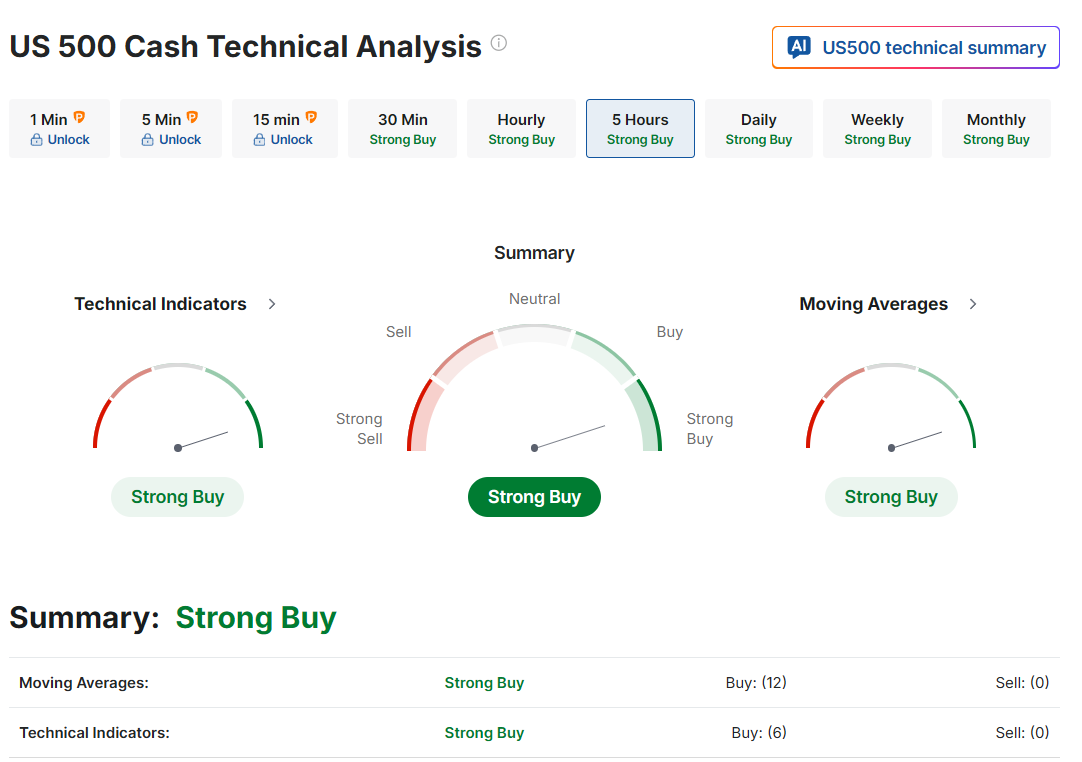
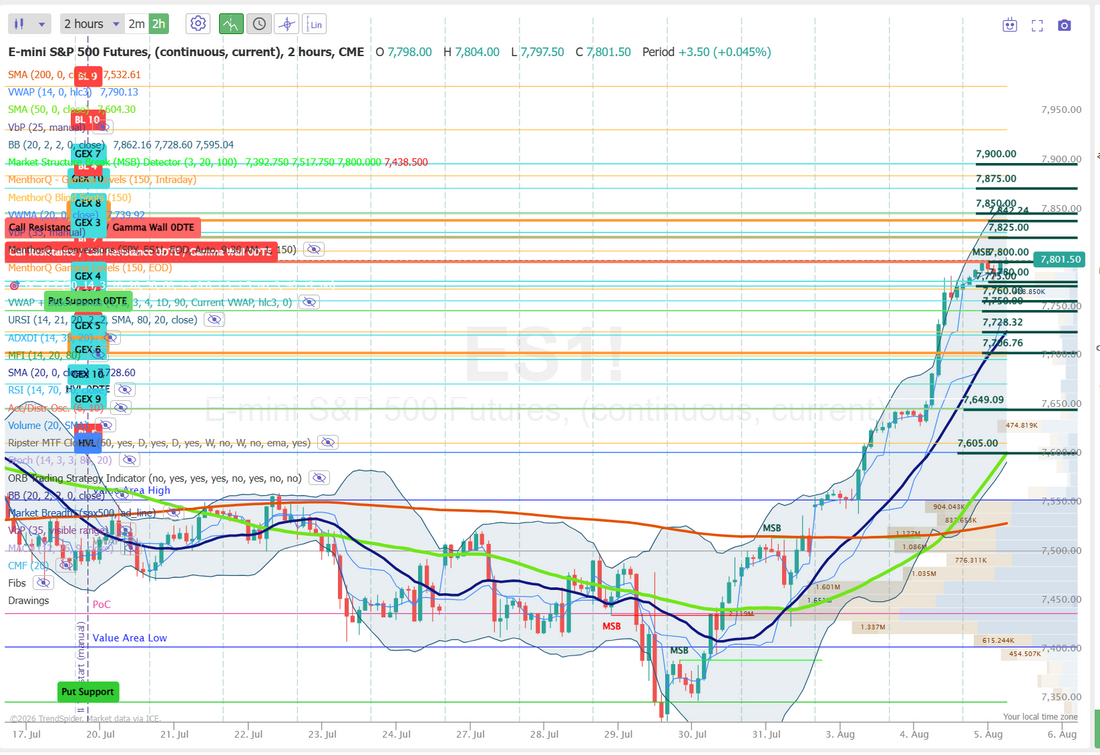
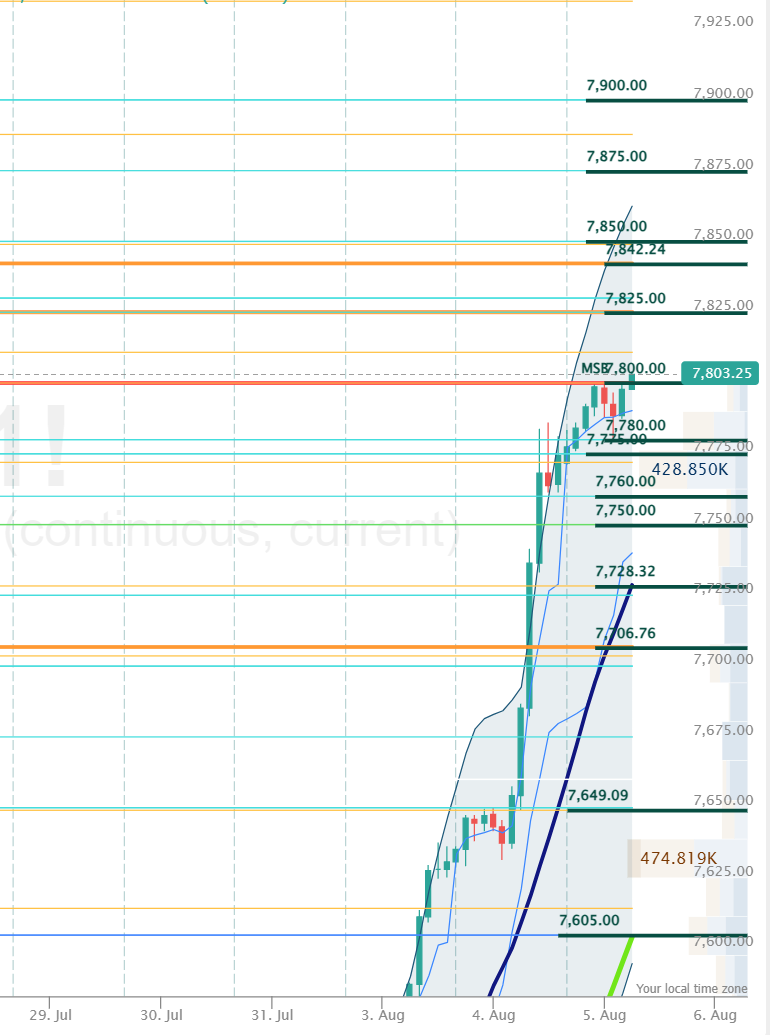
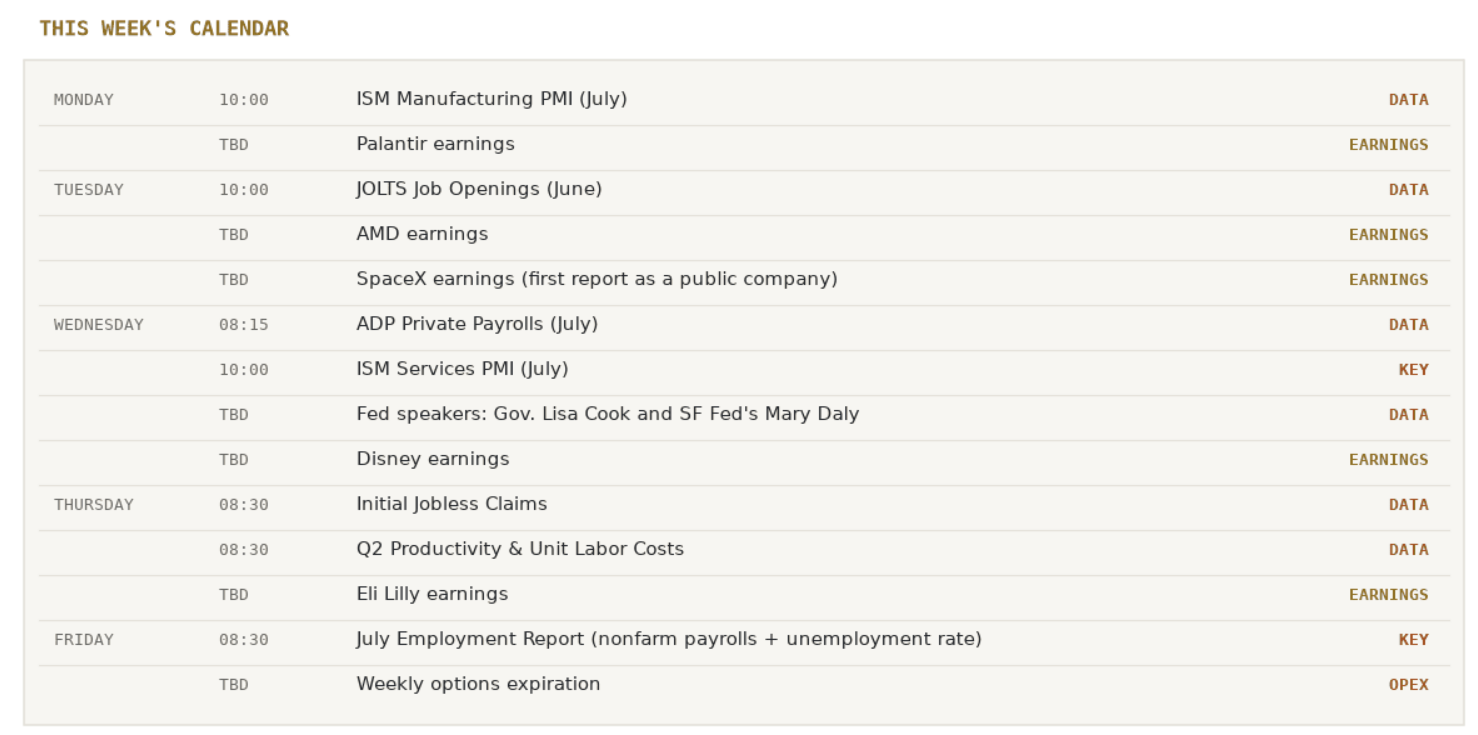
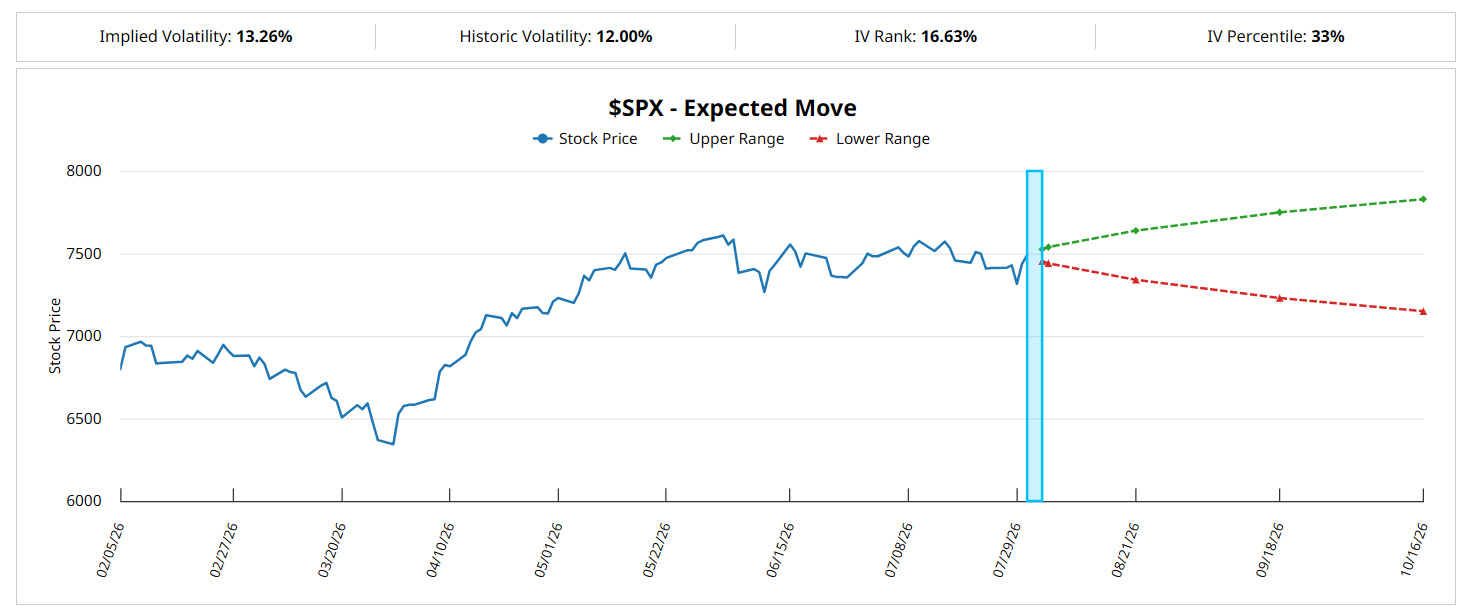
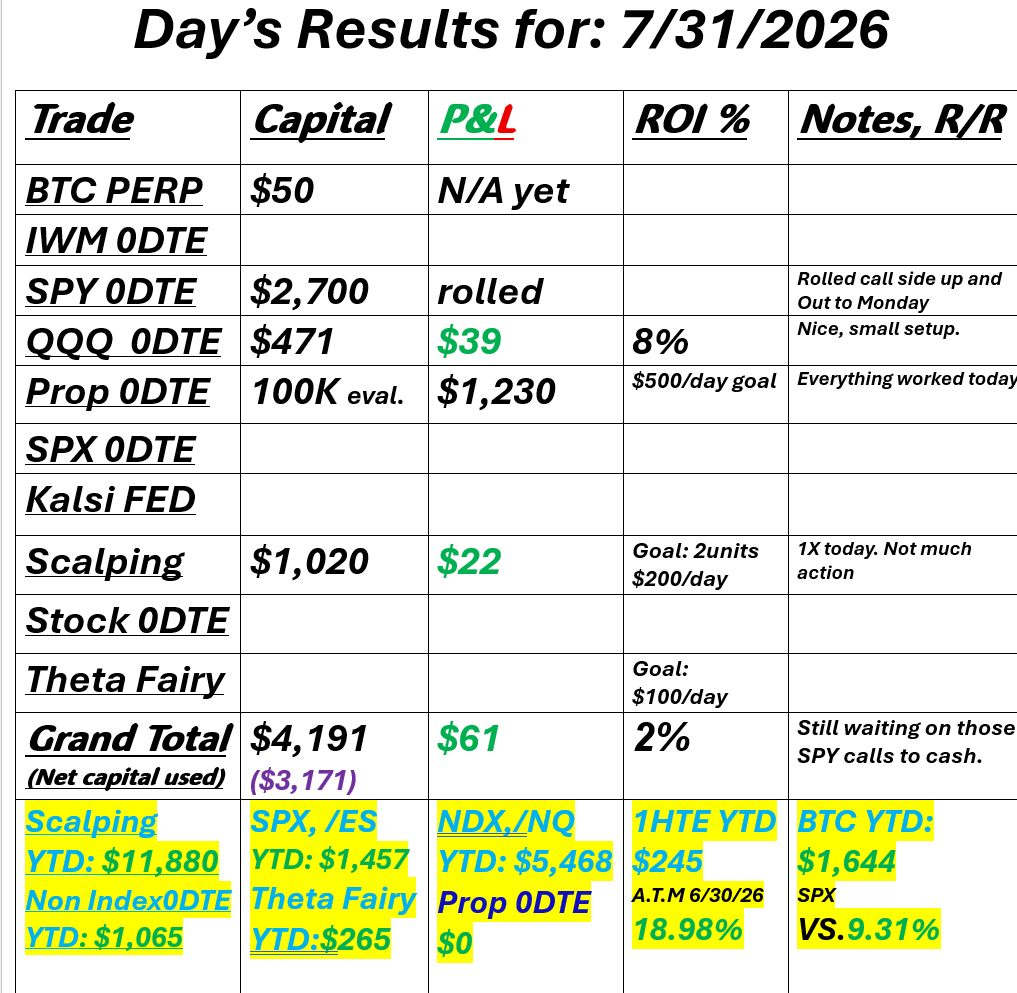
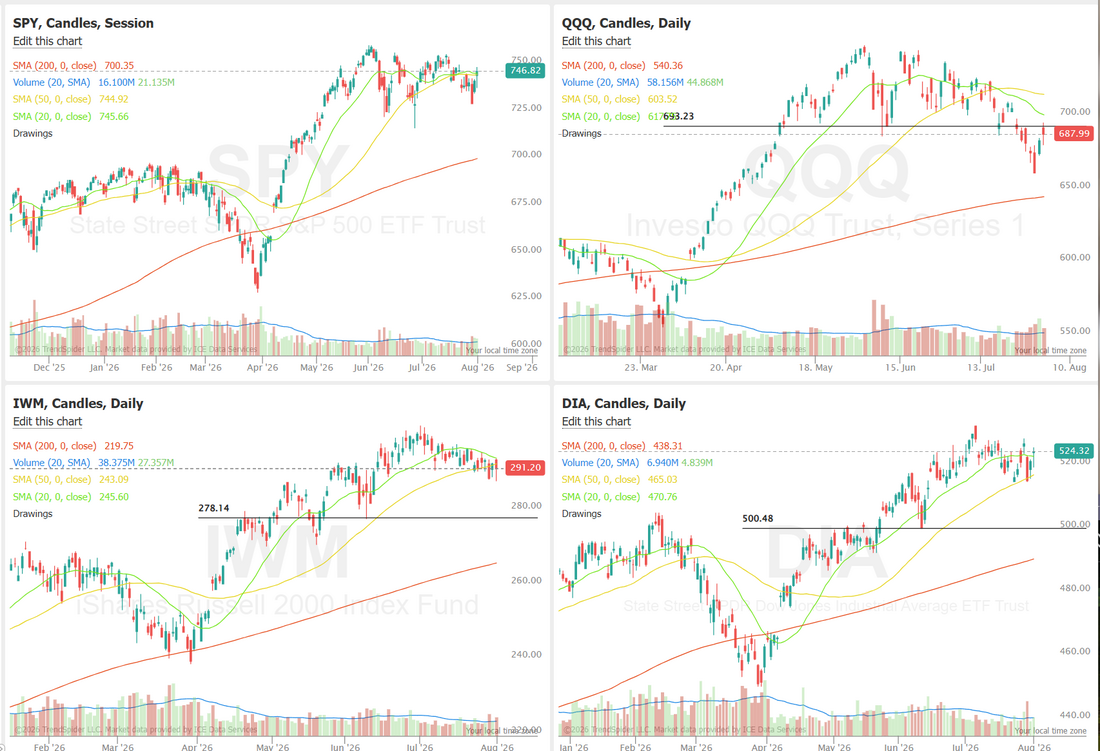
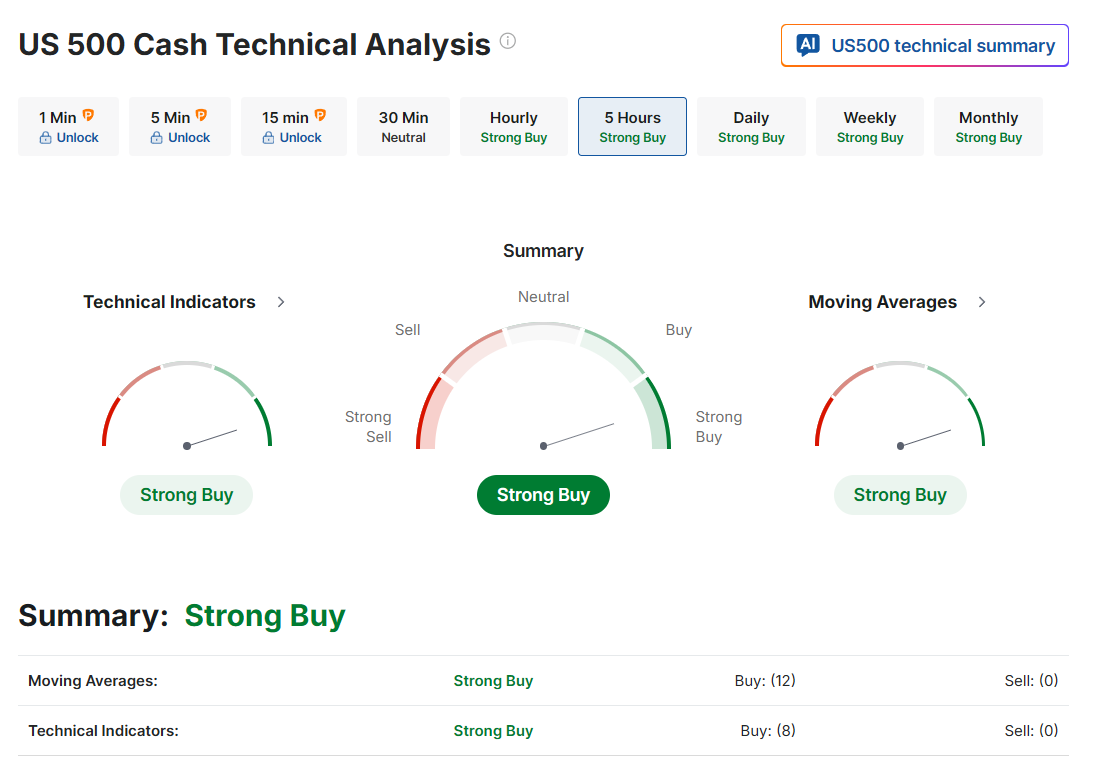
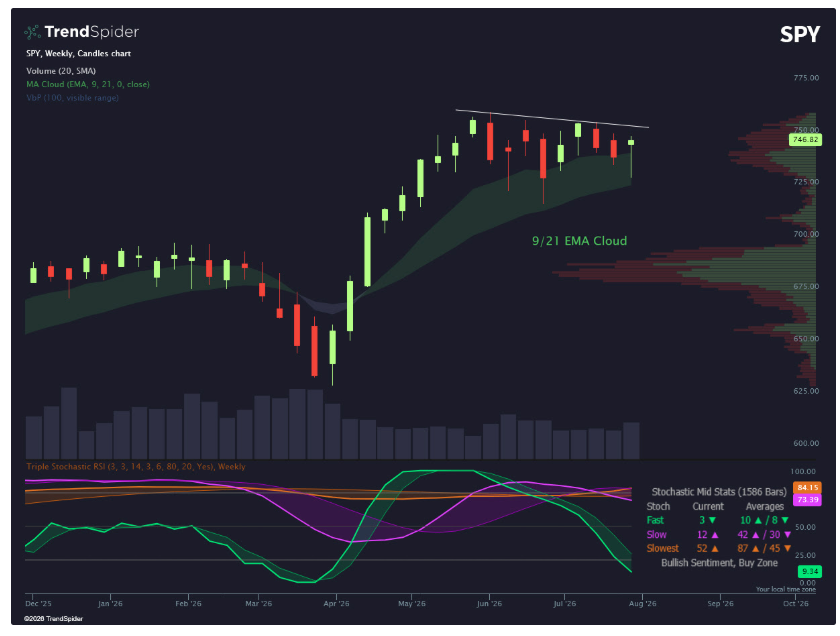
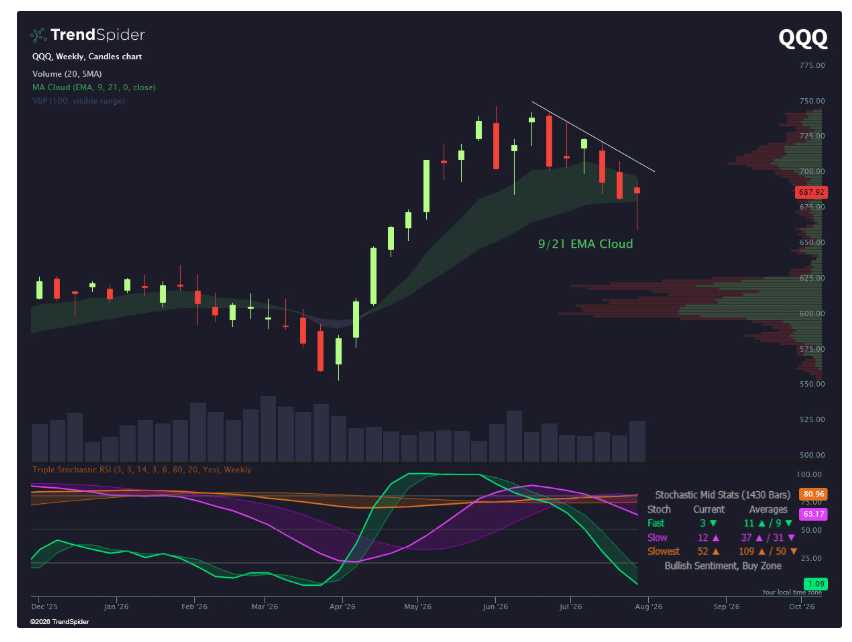
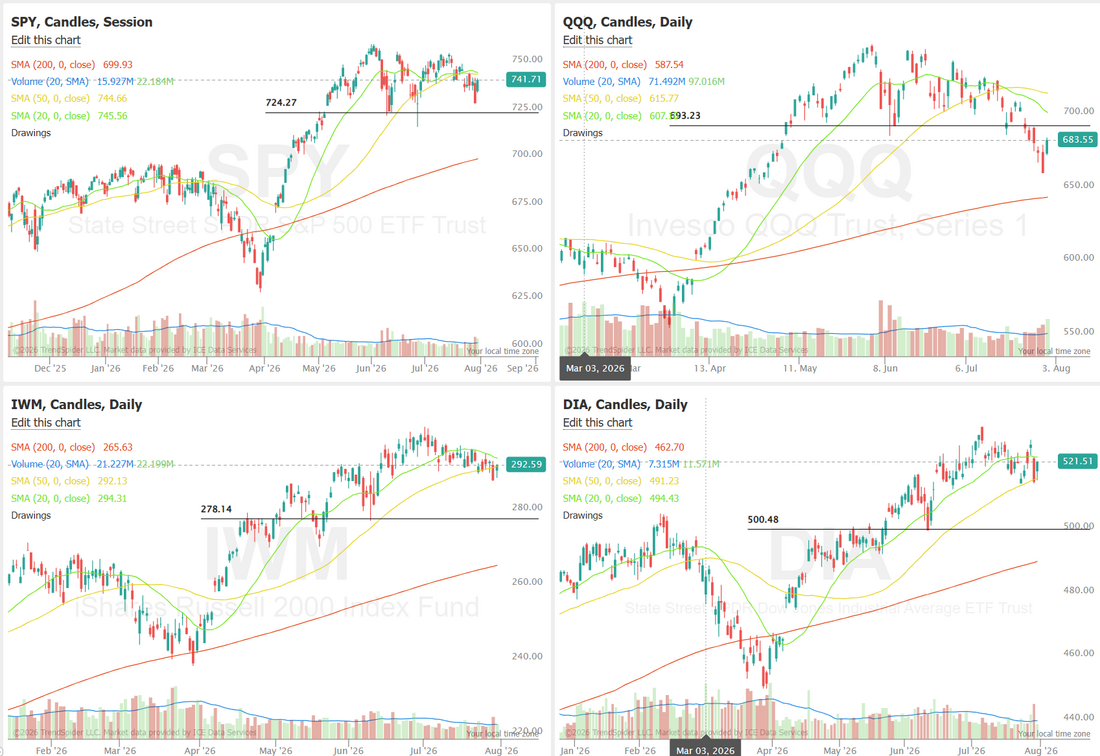
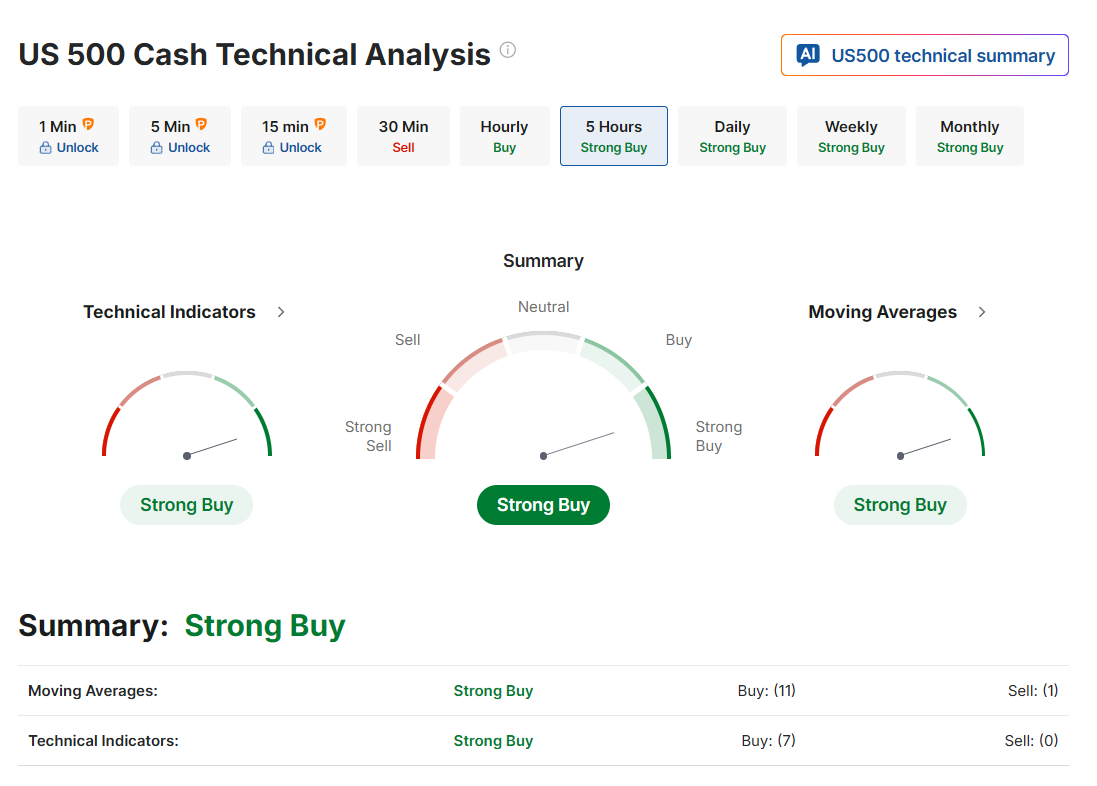
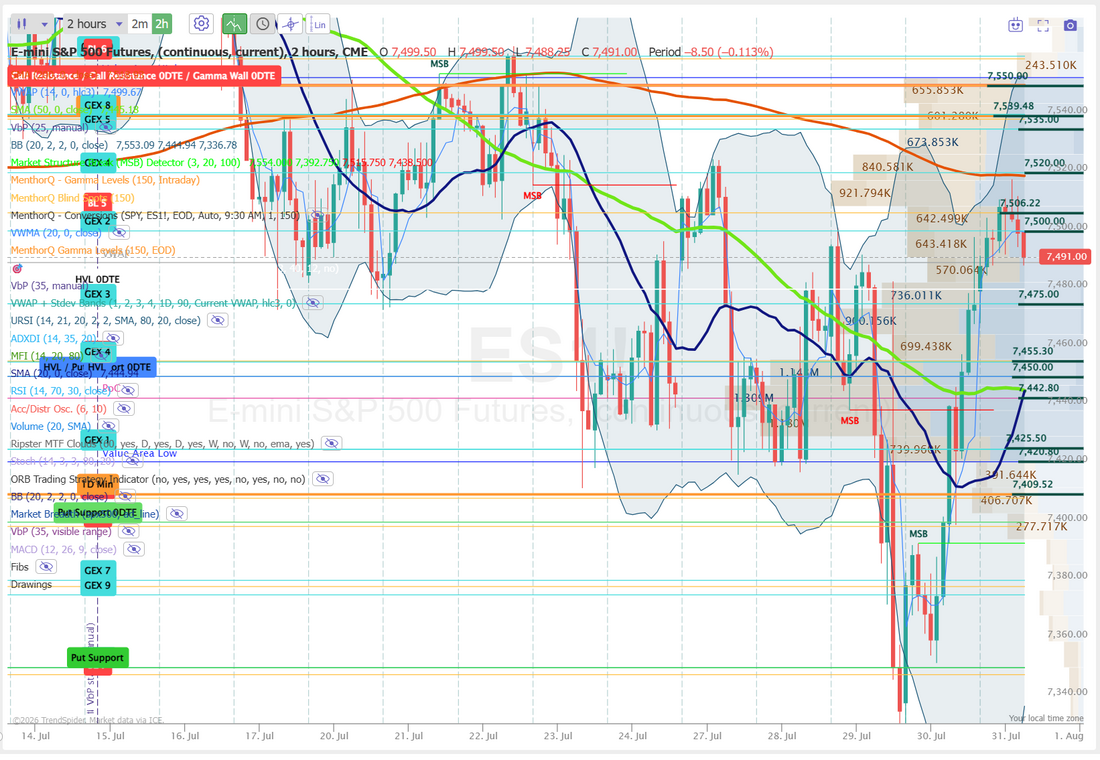
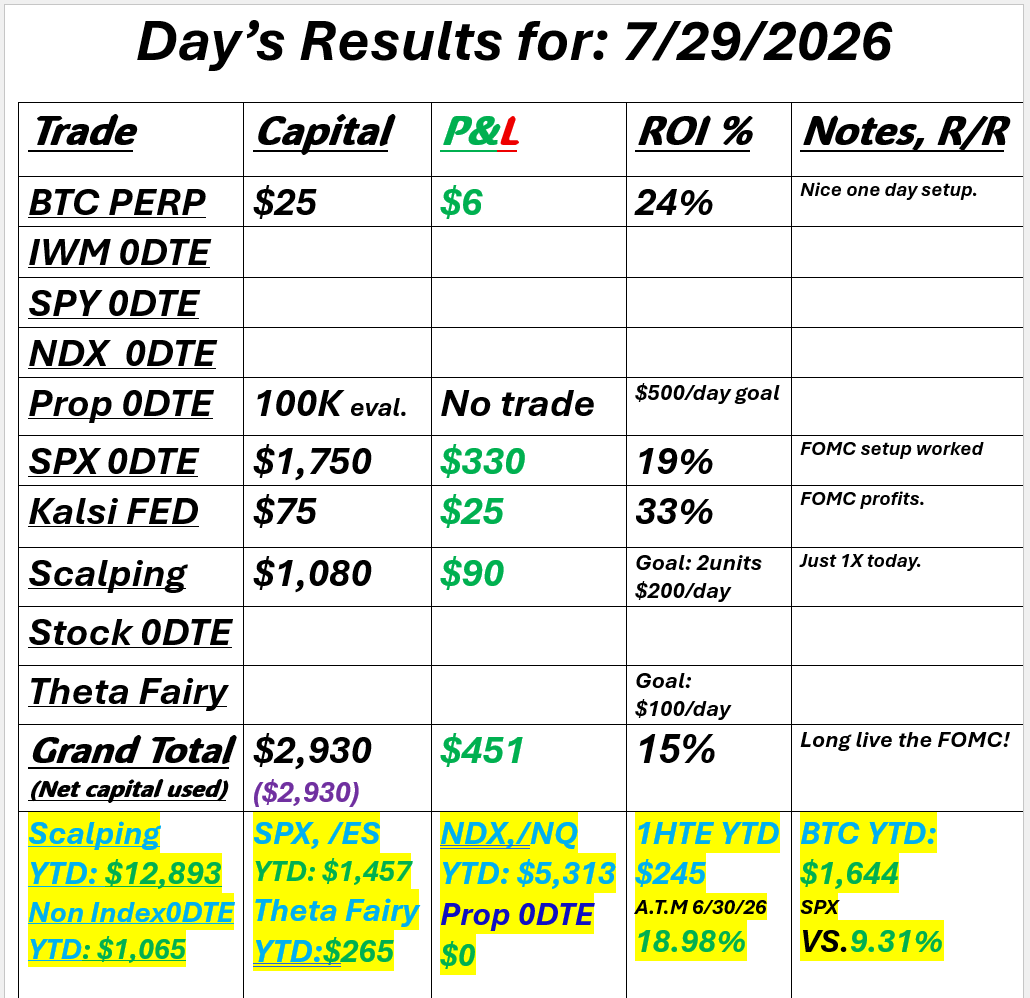
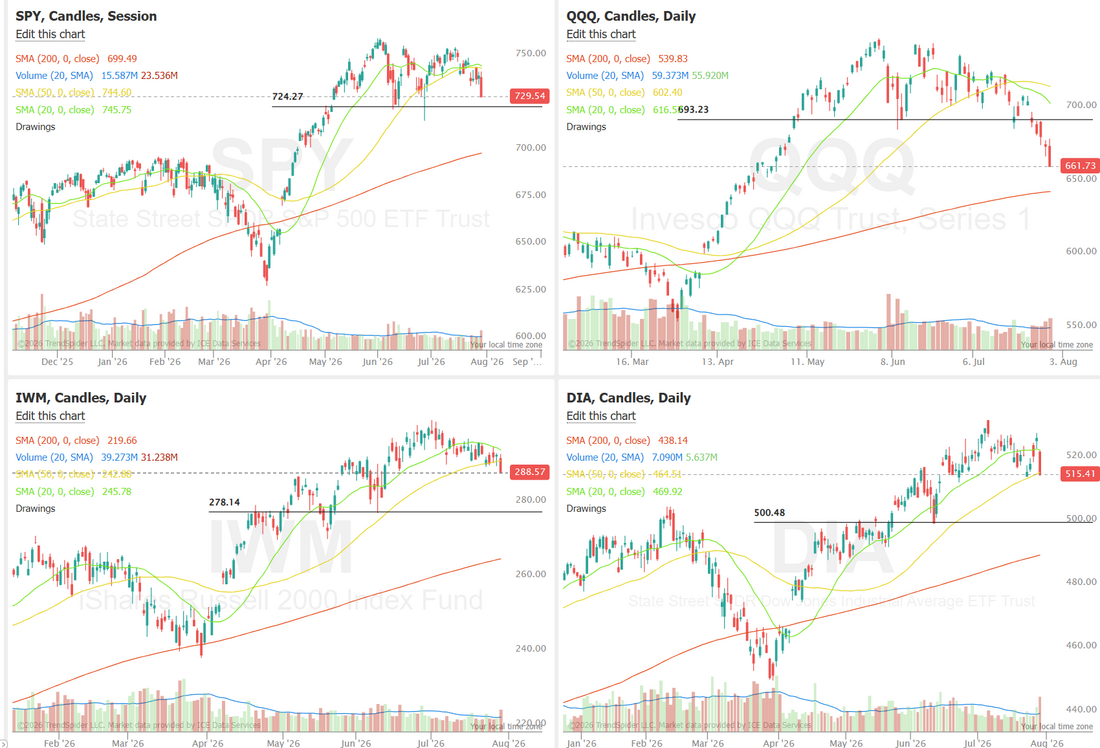
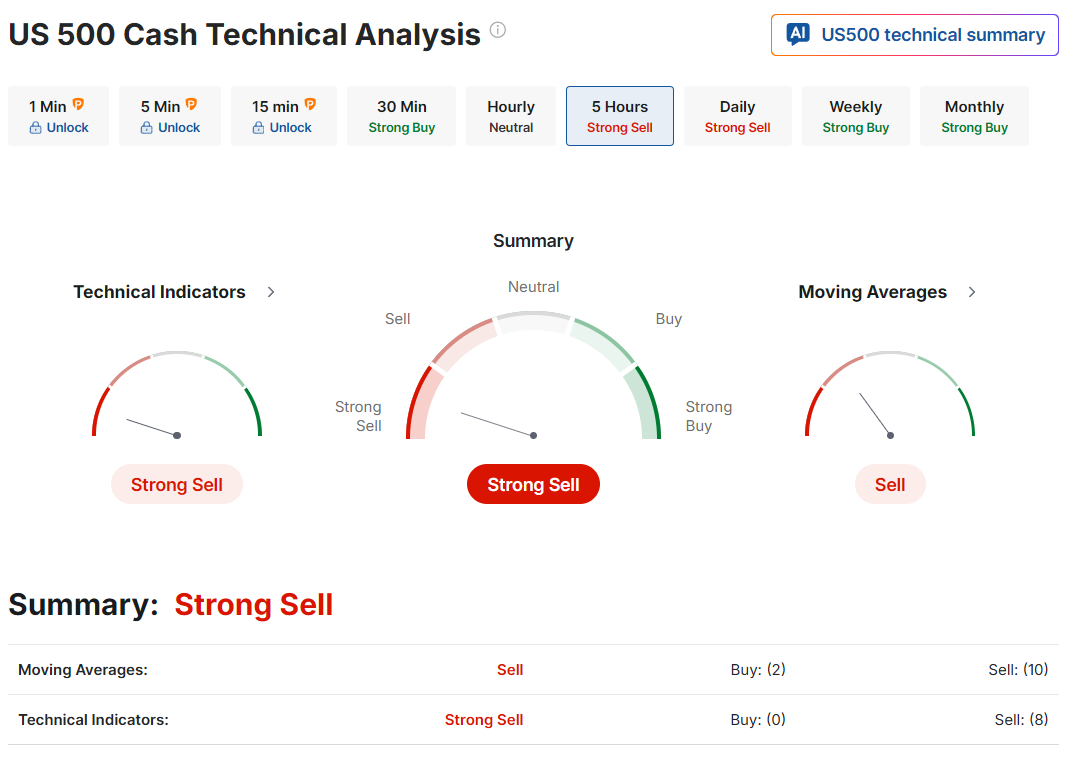
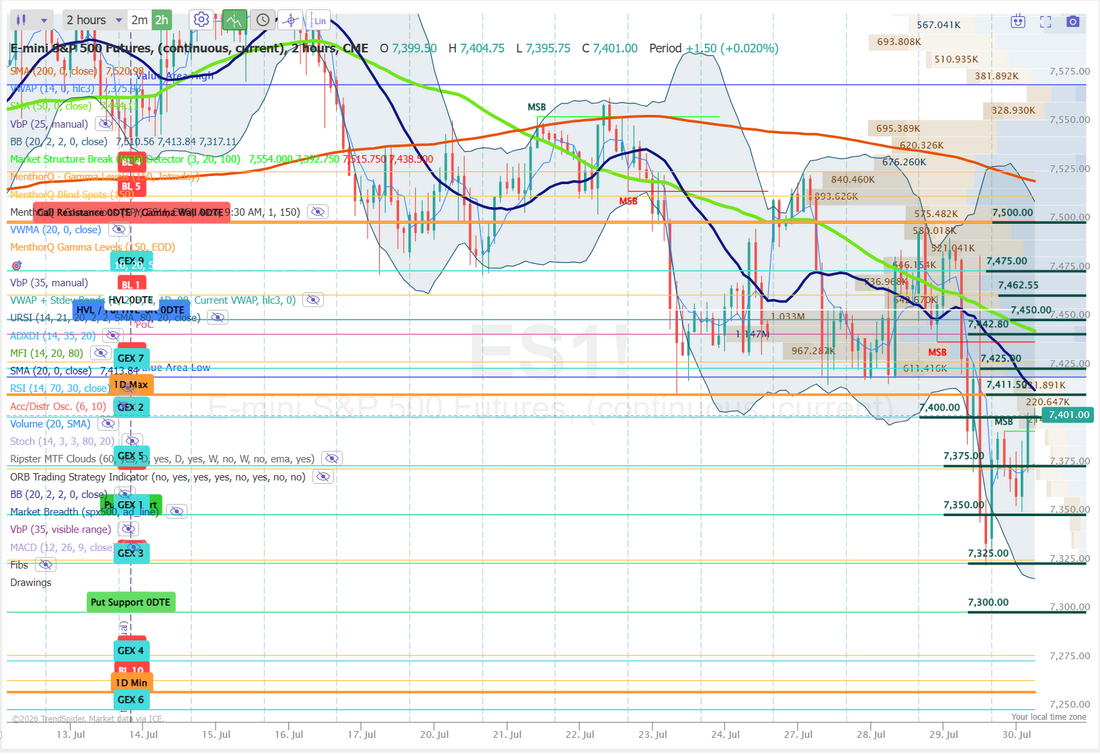
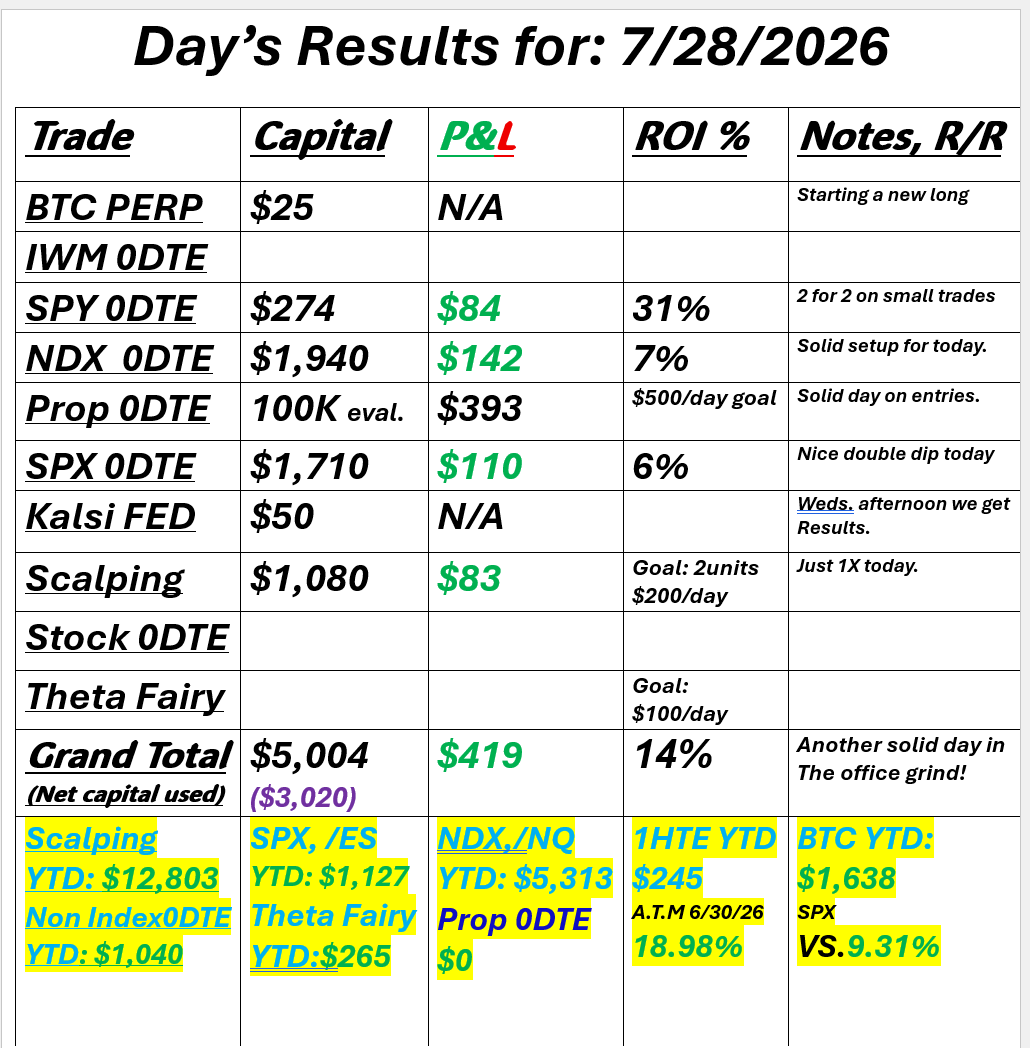
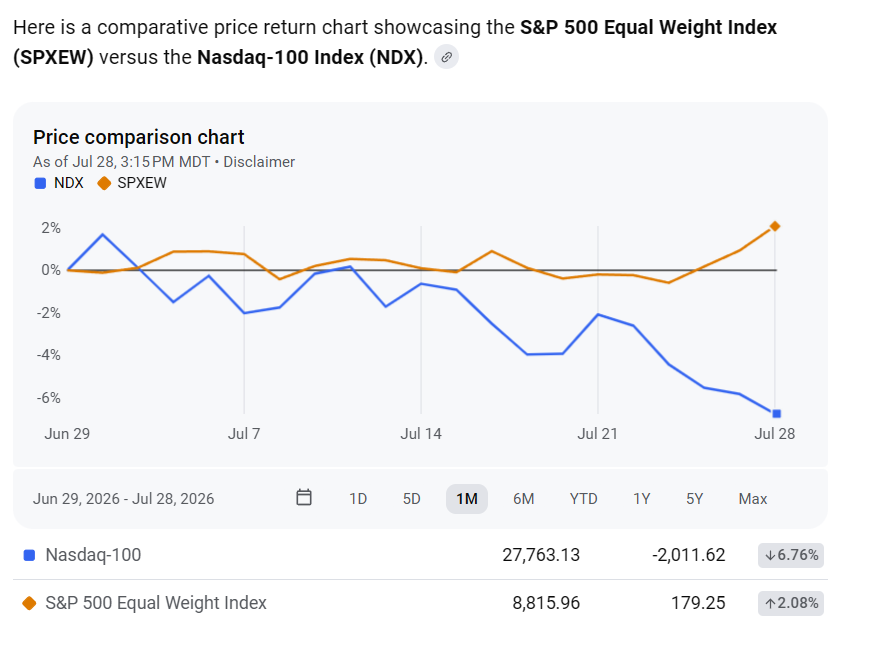
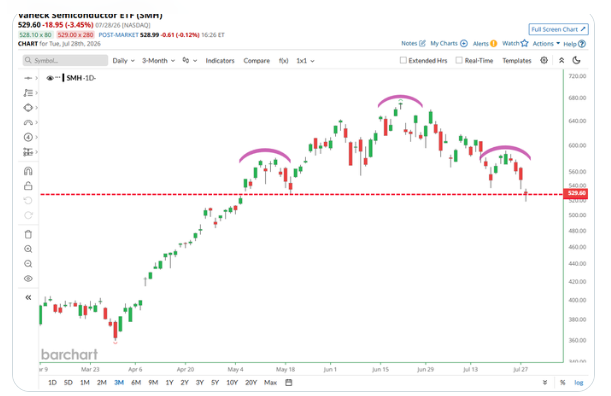
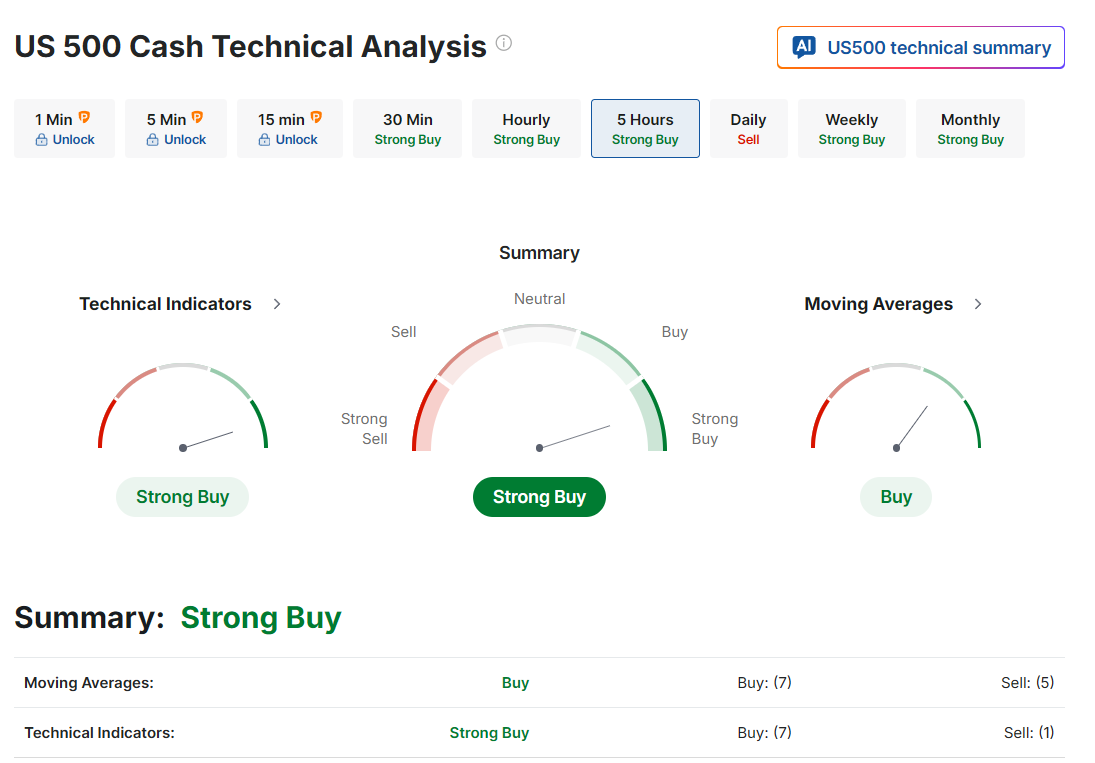
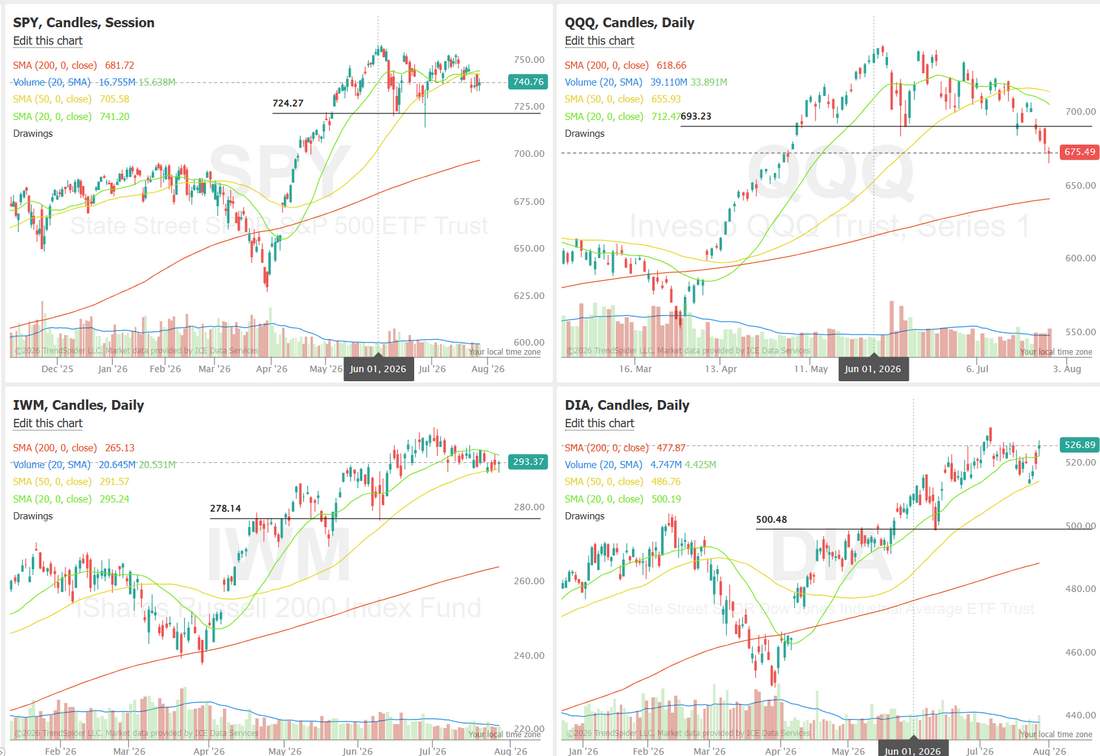
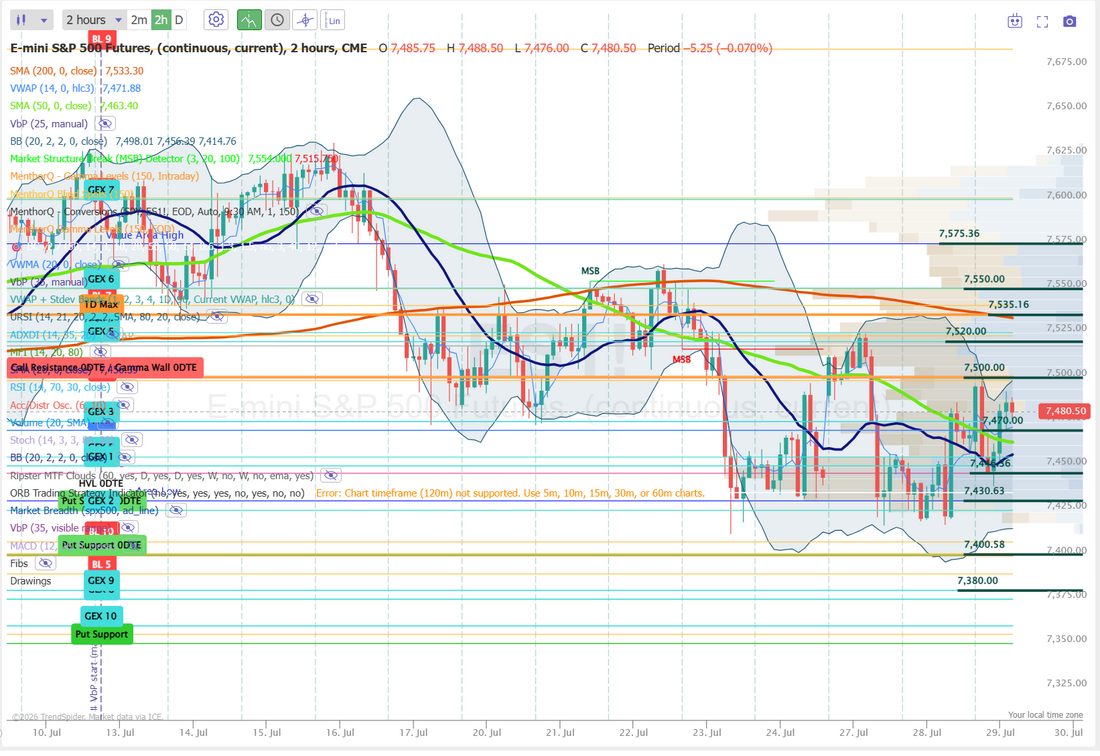
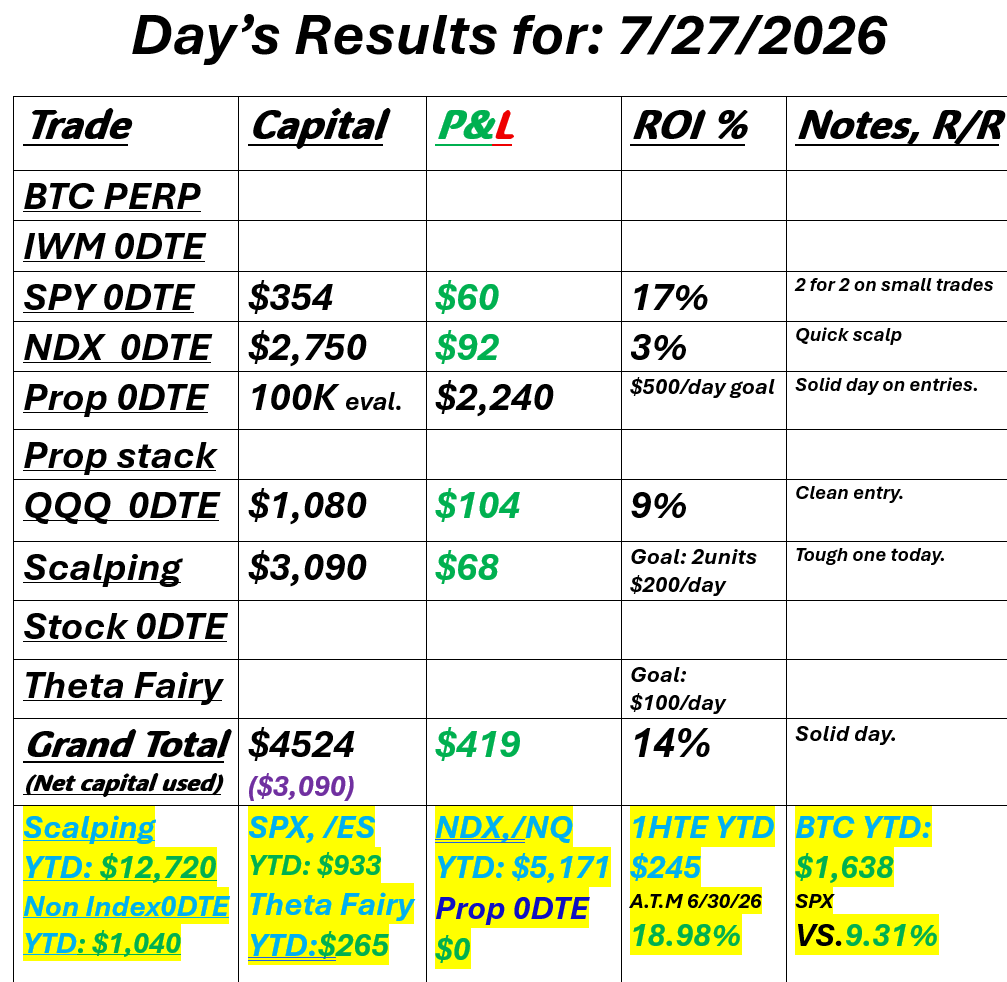
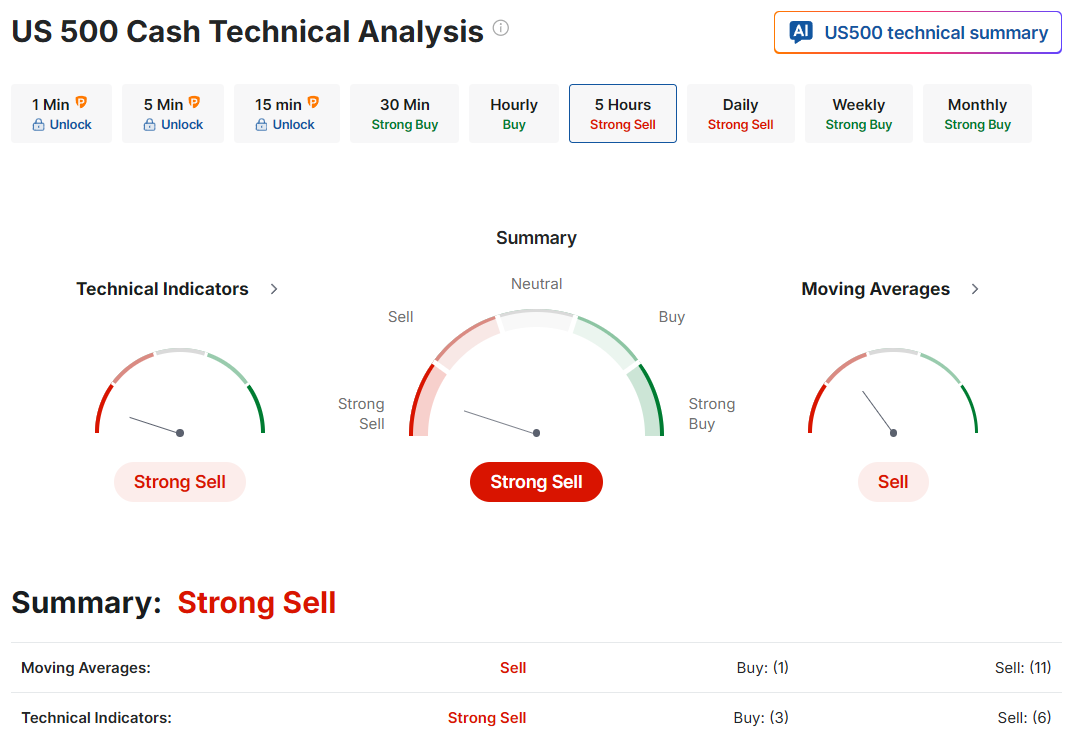
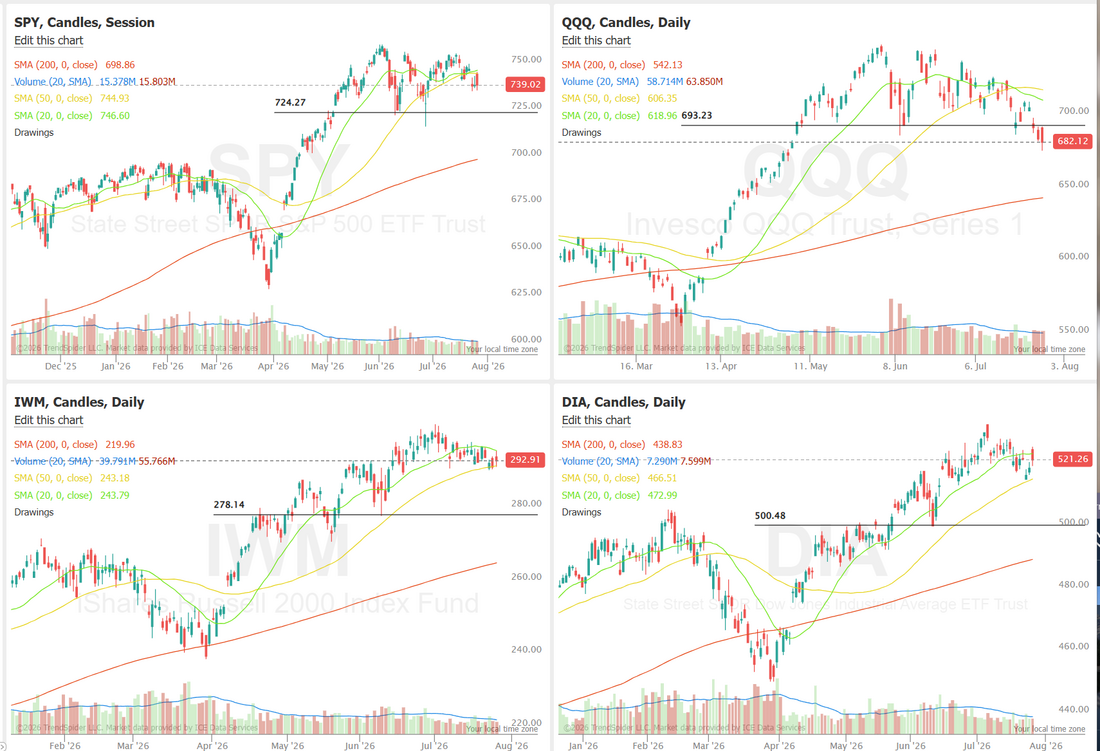
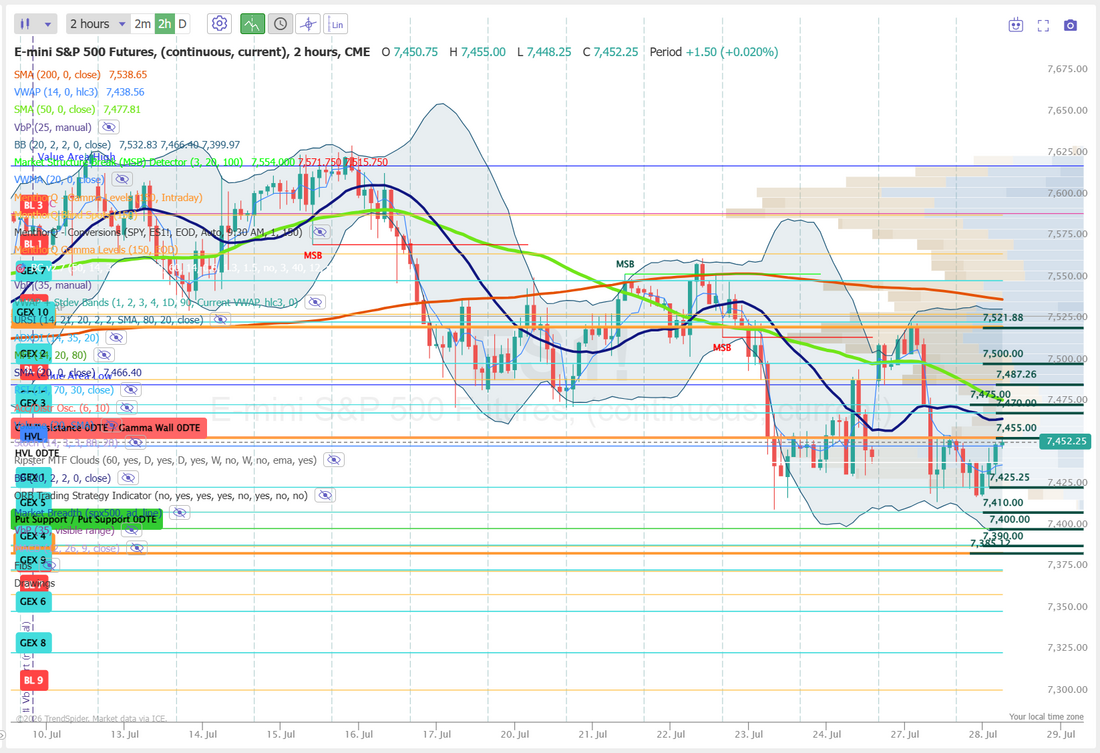
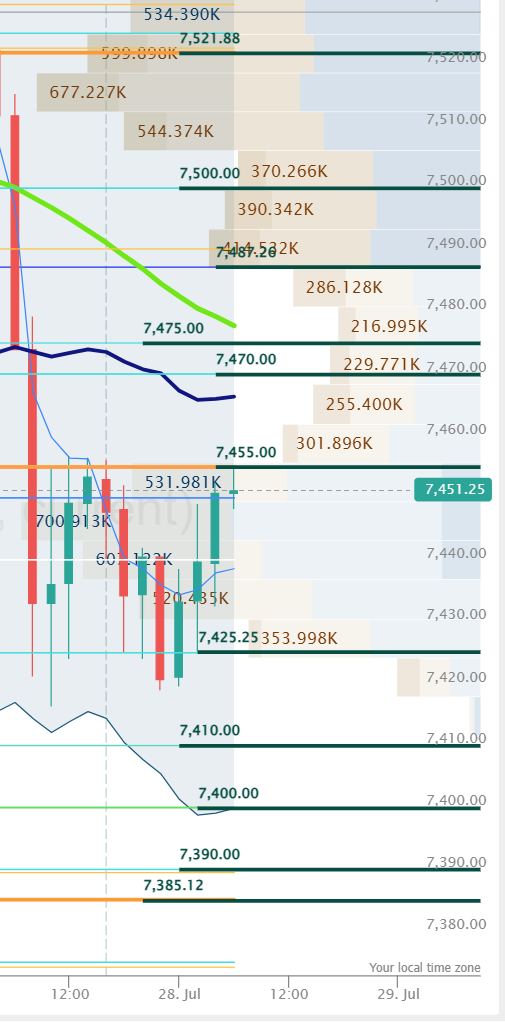
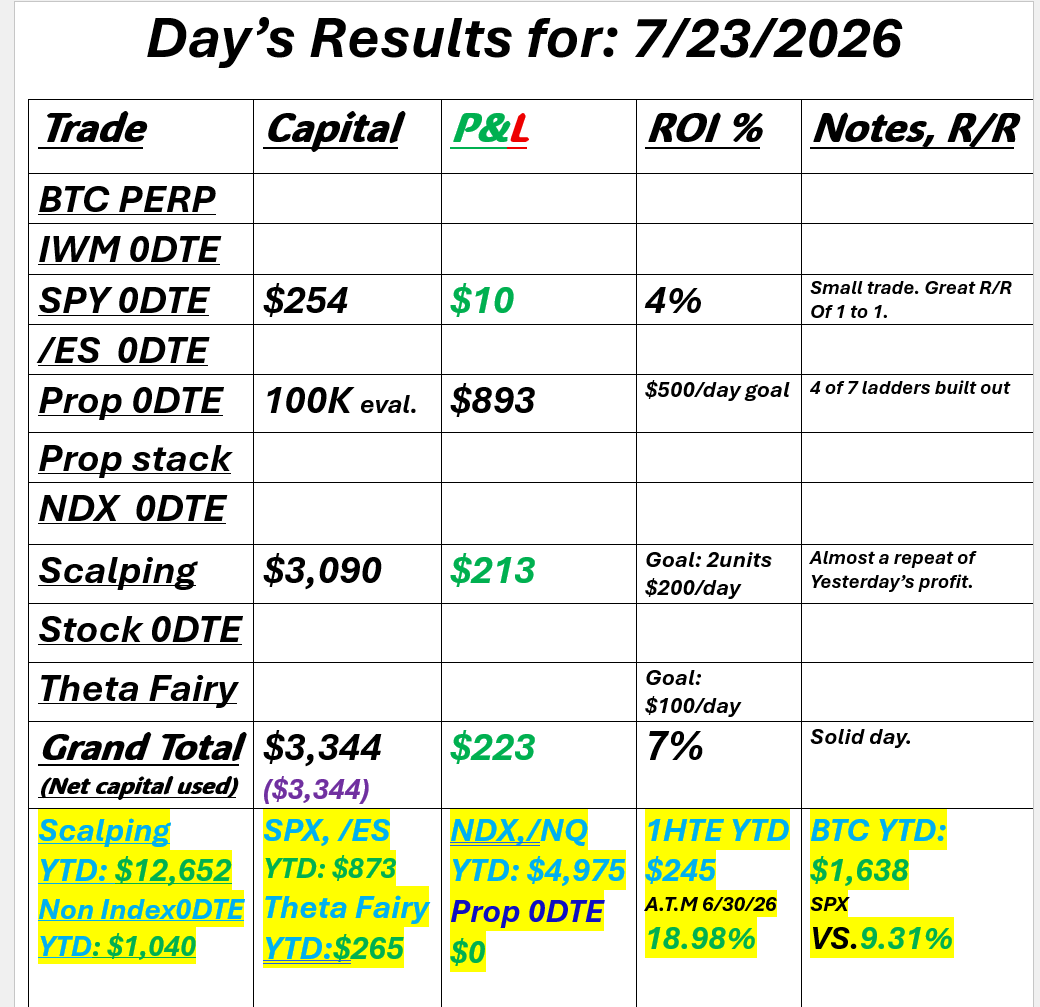
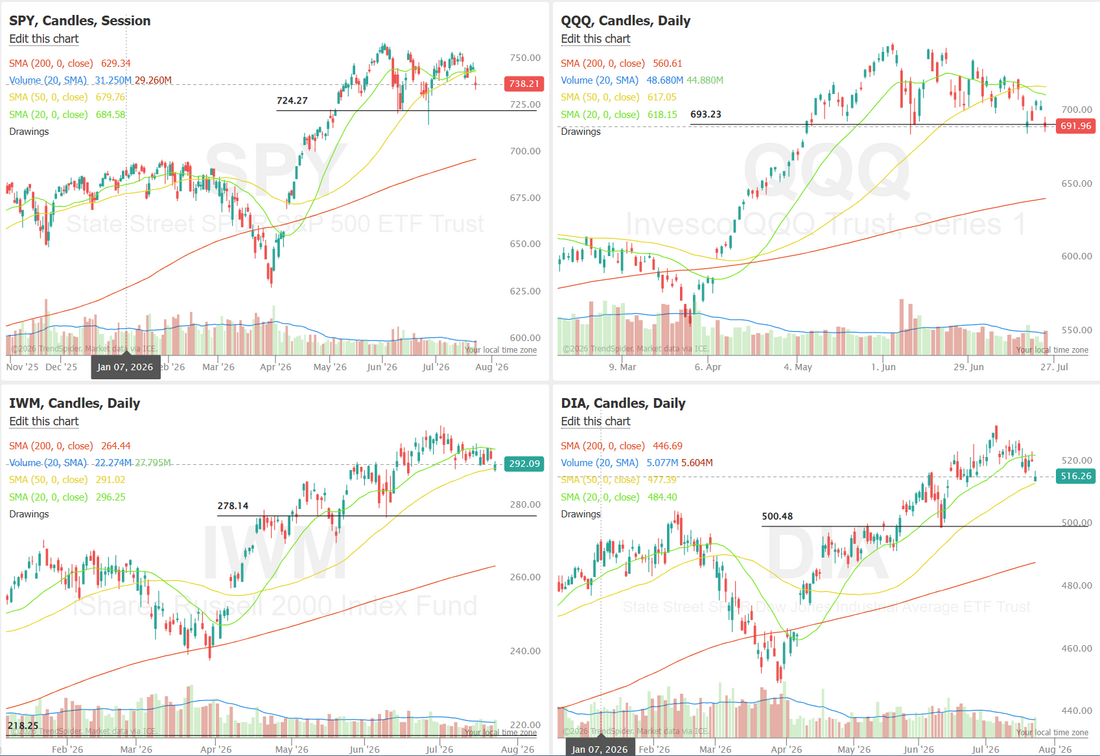
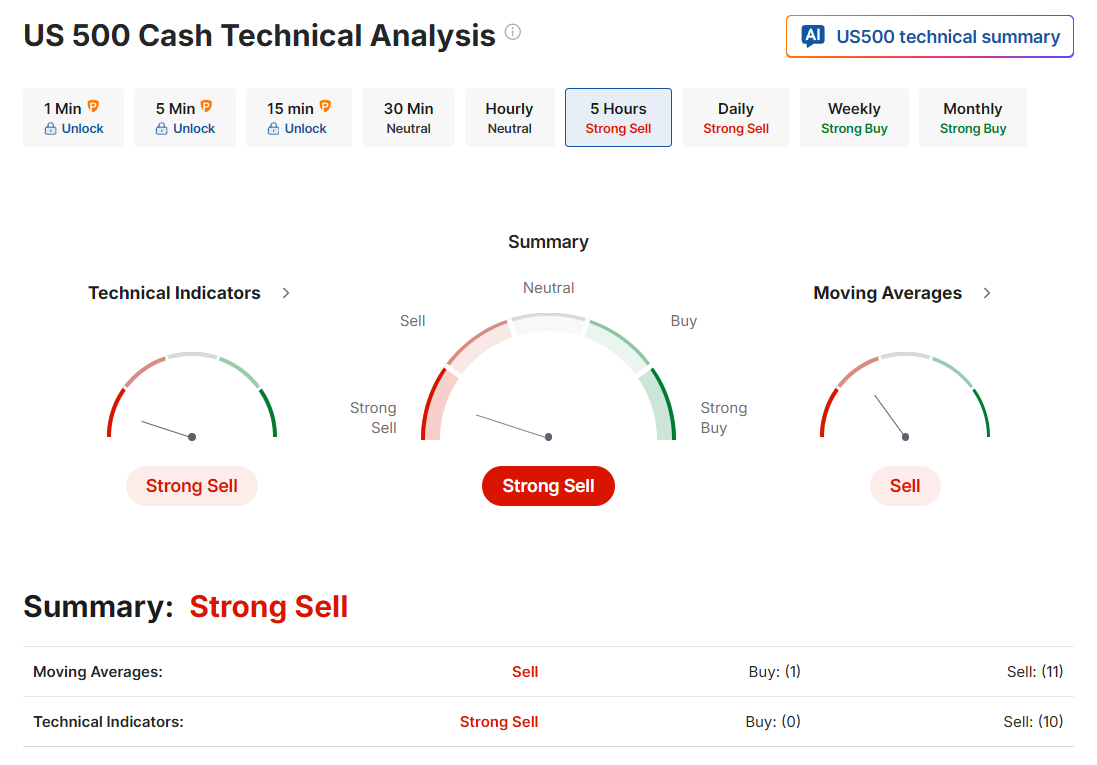
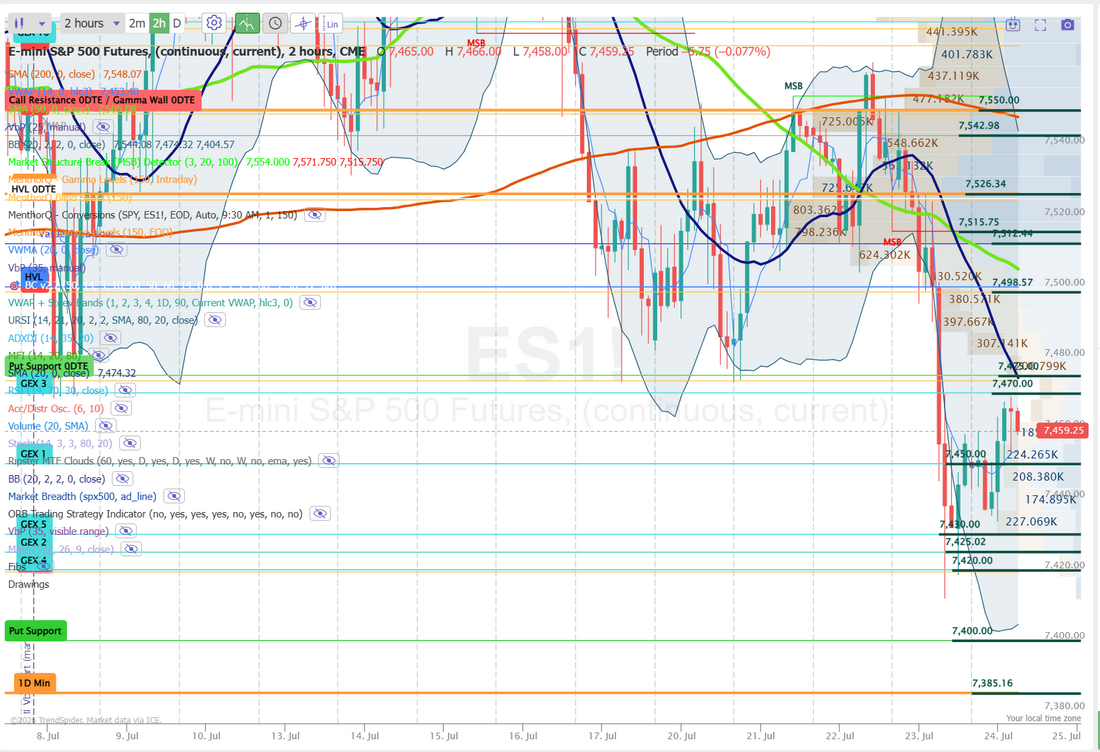
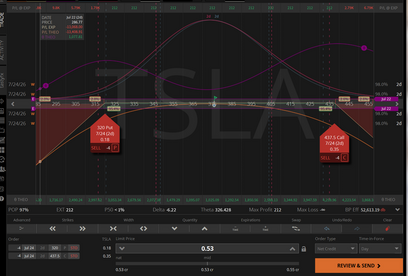
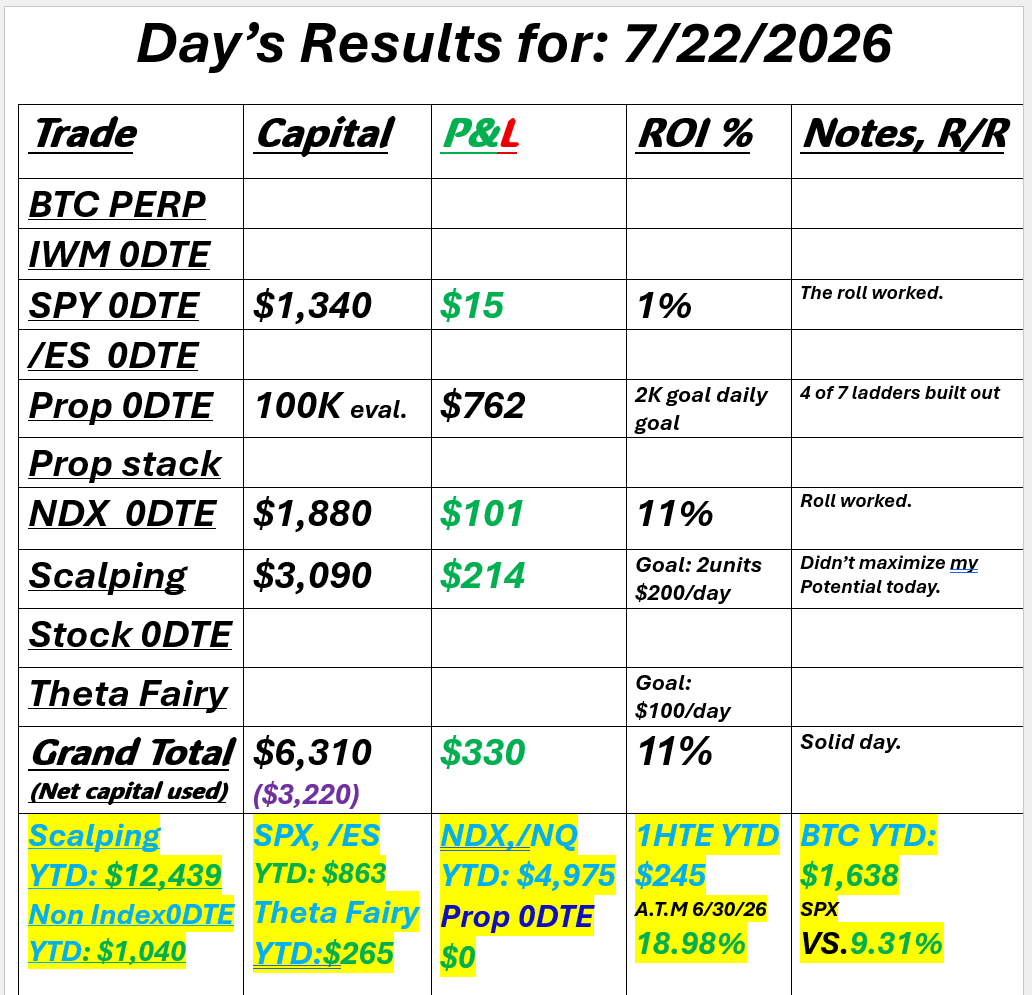
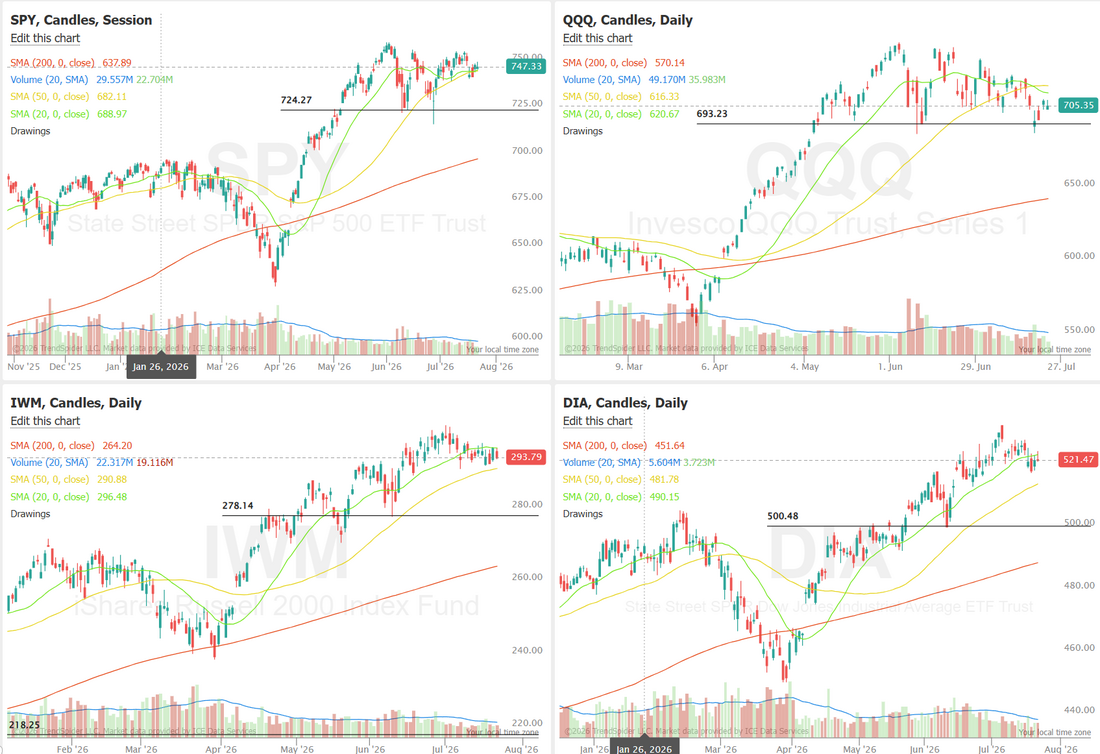
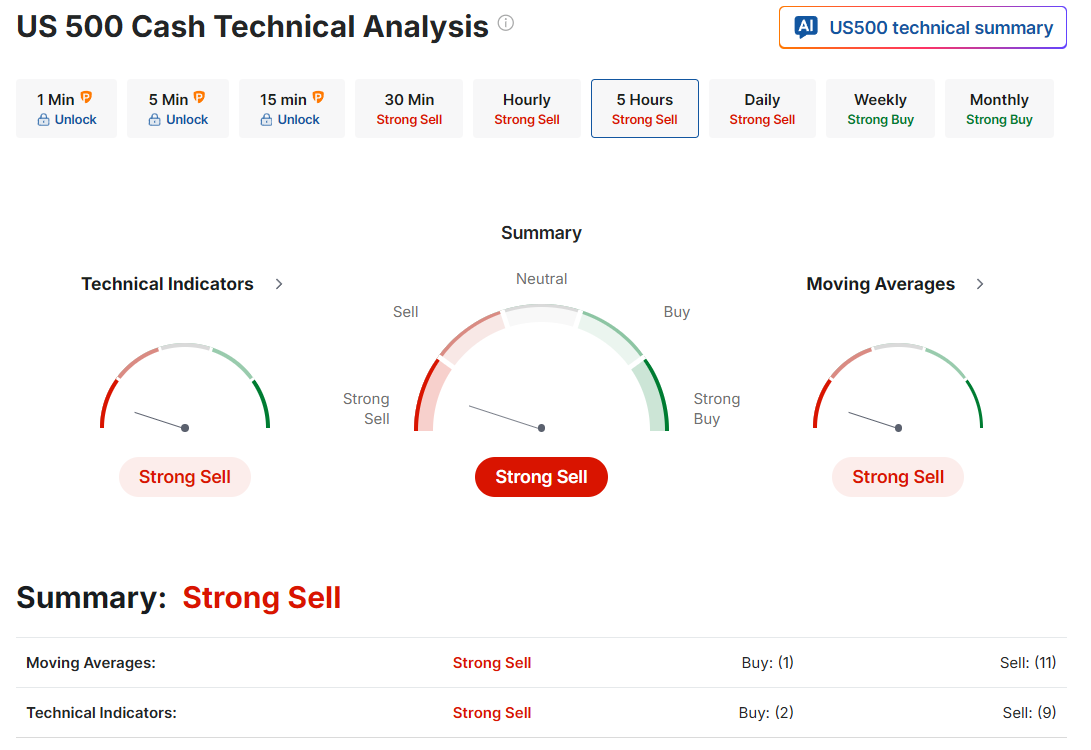
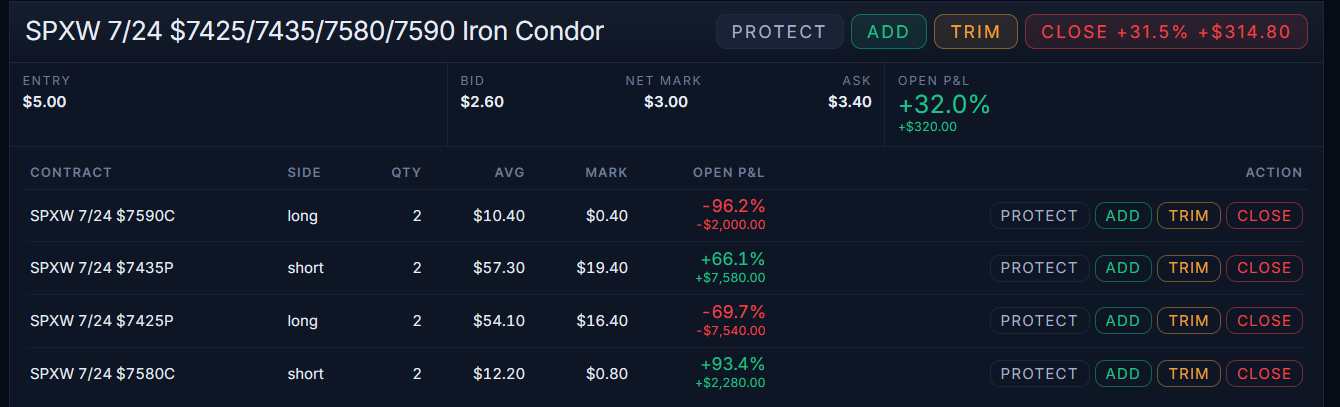
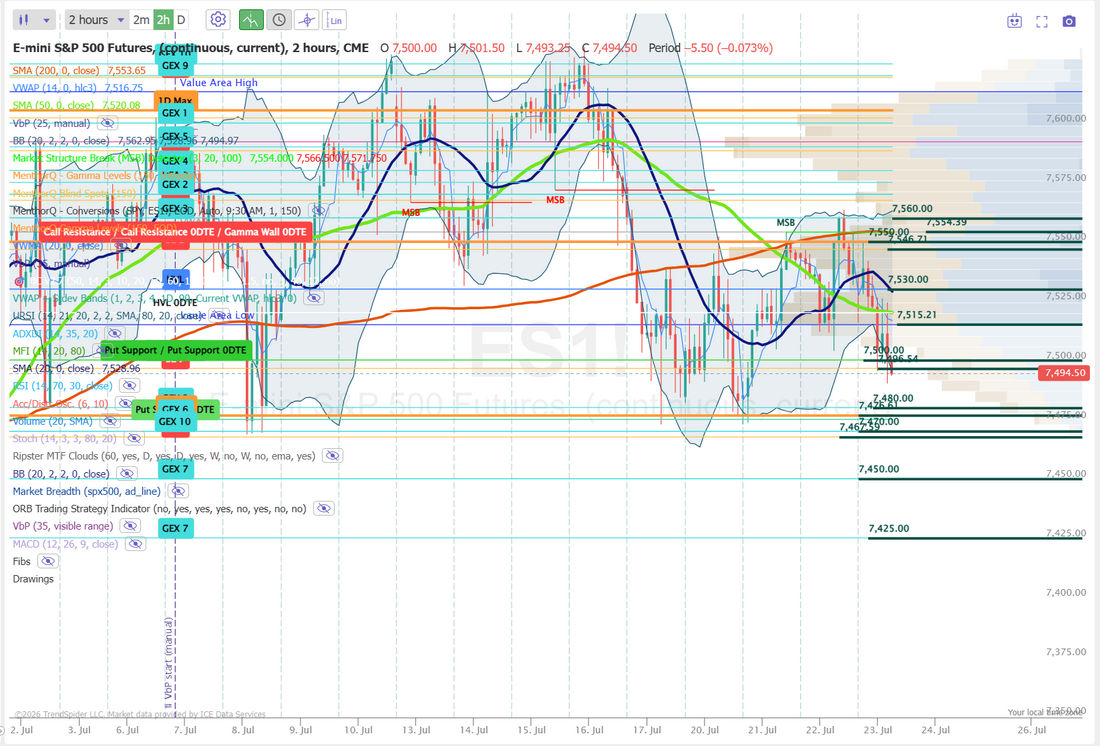
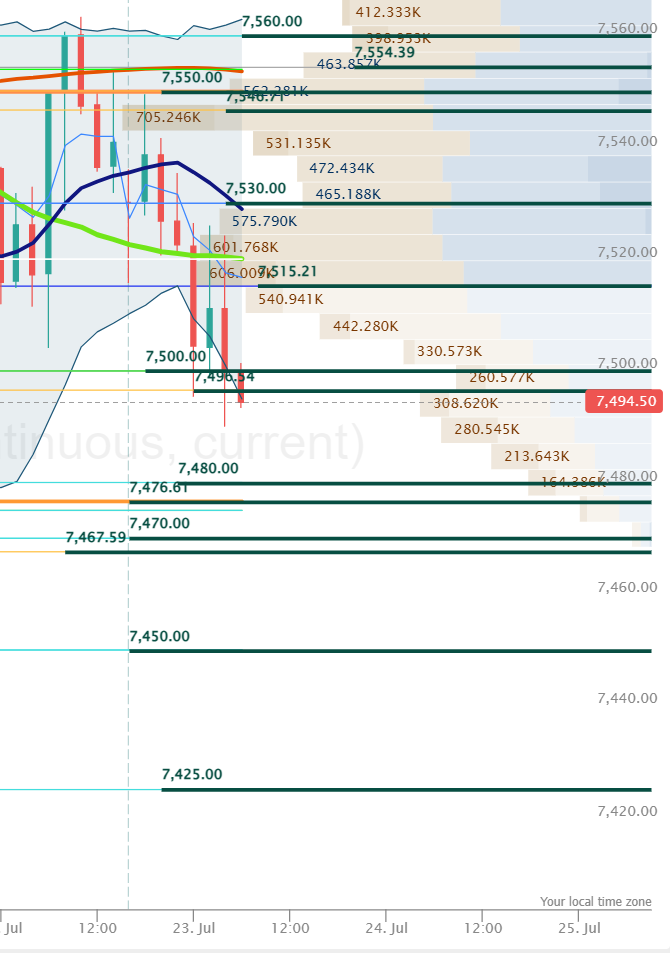
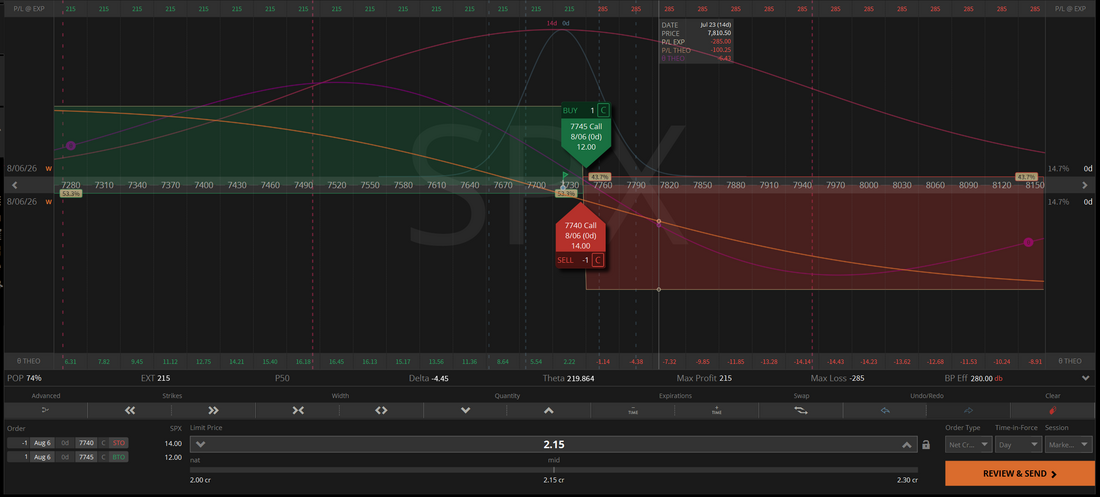
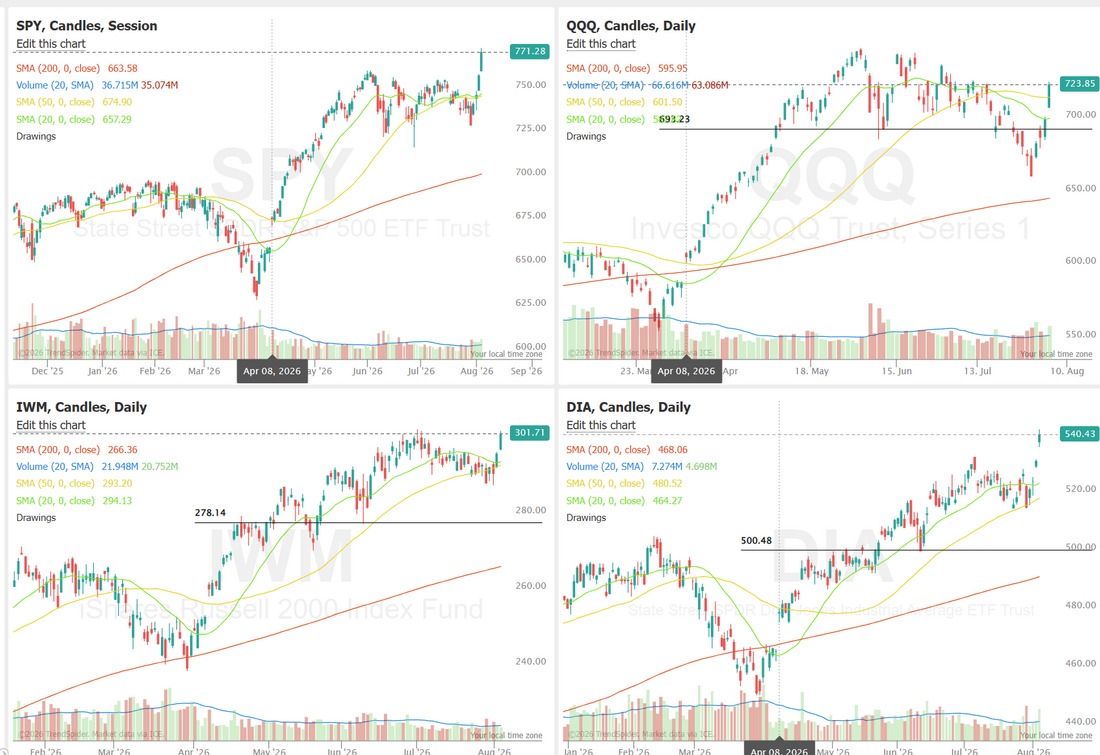
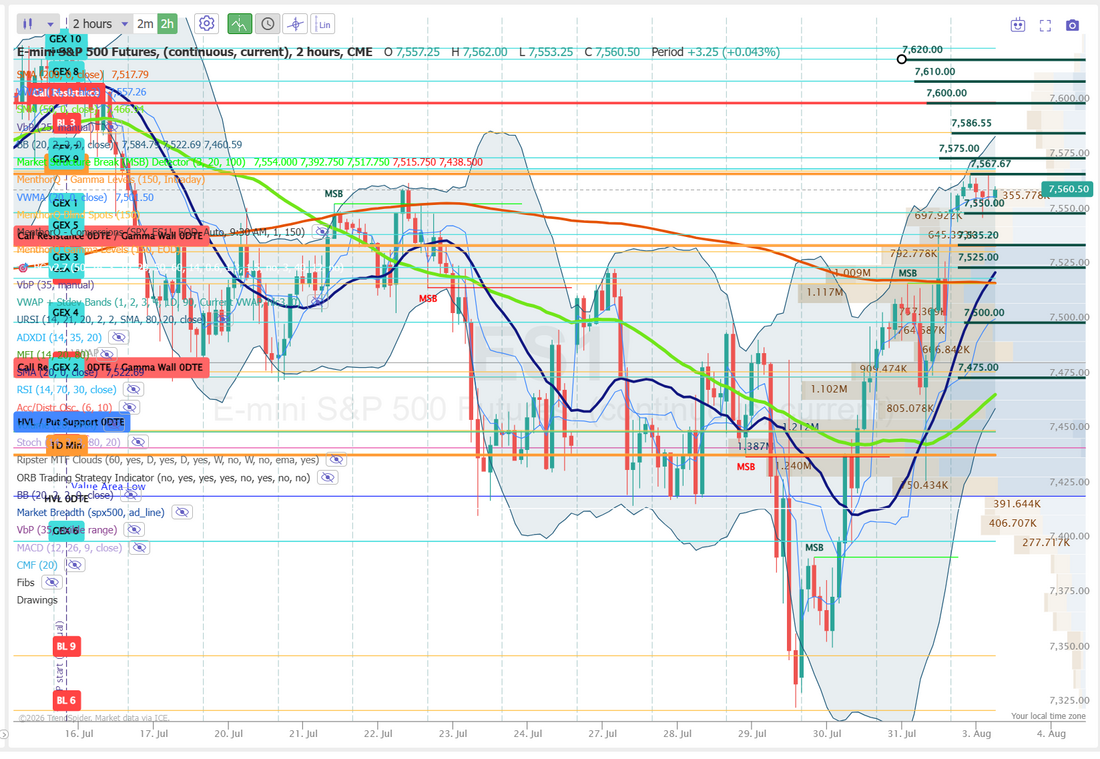
Overnight Vampire trade incomingIt's been a few expiration cycles since we've gotten an overnight Vampire trade working. We got one on yesterday so that should be a nice little profit to start off our day when the cash markets open up. Our day yesterday was another excellent one of risk management and great ROI. My risk went a bit higher on our SPX trade than I like but it was still workable. Here's a look at our day. Everything hit for a profit. Our mantra for yesterday was, "No green to red" so we were diligent on locking the gains in. Let's take a look at the markets. Monday of this week we looked at the expected weekly move and laughed. It looked ridiculously low. Well guess what? We didn't go anywhere! It was right. Lots of churning sideways. Technicals don't really give us much to go off. Leaning slightly bullish. March Nasdaq 100 E-Mini futures (NQH26) are trending up +0.59% this morning, signaling that a tech rally fueled by strong earnings from Taiwan Semiconductor Manufacturing Co., which revived optimism around AI, looks set to continue. Also aiding sentiment, shares of memory chipmakers rallied in pre-market trading, led by a more than +6% gain in Micron Technology (MU) after the company disclosed in a regulatory filing that director Teyin Liu bought about $7.8 million worth of shares this week. SanDisk (SNDK) climbed over +5% and Western Digital (WDC) rose more than +4%. In yesterday’s trading session, Wall Street’s major indices ended in the green. U.S.-listed shares of Taiwan Semiconductor Manufacturing Co. (TSM) climbed over +4% after the world’s biggest contract chipmaker posted a record Q4 profit, projected faster-than-expected 2026 revenue growth, and provided blockbuster capital expenditure guidance for this year. Also, chip stocks rallied following TSMC’s results and guidance, with KLA Corp. (KLAC) jumping more than +7% to lead gainers in the S&P 500 and Nasdaq 100, and Applied Materials (AMAT) rising over +5%. In addition, BlackRock (BLK) advanced more than +5% after the world’s largest asset manager reported stronger-than-expected Q4 results. On the bearish side, Coinbase Global (COIN) slumped over -6% after the Senate Banking Committee delayed a hearing on a key cryptocurrency bill on Wednesday following Coinbase’s withdrawal of support. The Labor Department’s report on Thursday showed that the number of Americans filing for initial jobless claims in the past week unexpectedly fell by -9K to a 6-week low of 198K, compared with the 215K expected. Also, the U.S. Philly Fed manufacturing index rose to a 4-month high of 12.6 in January, stronger than expectations of -1.6. In addition, the U.S. January Empire State manufacturing index rose to 7.70, stronger than expectations of 0.80. Finally, the U.S. import price index unexpectedly rose +0.4% m/m in November, stronger than expectations of -0.1% m/m. “If earnings continue to beat expectations and economic data remains supportive, the likely path remains advance, backfill, then advance again,” said Kenny Polcari at SlateStone Wealth. Chicago Fed President Austan Goolsbee said on Thursday that the central bank’s primary focus should be curbing inflation, as the labor market shows signs of stabilizing. “We’ve been five years fighting to get inflation on a path back to 2% and we made some progress, but we need that, and if we get that, I think rates can come down,” Goolsbee said. Also, Atlanta Fed President Raphael Bostic said, “We need to make sure that we stay in a restrictive stance, because inflation is still too high, and those high prices are weighing on so many Americans.” In addition, Kansas City Fed President Jeff Schmid said interest rates should remain at levels that continue to exert some pressure on the economy, allowing inflation to cool further. Finally, San Francisco Fed President Mary Daly said she believes monetary policy is “in a good place” as risks to both sides of the central bank’s dual mandate remain. Meanwhile, U.S. rate futures have priced in a 95.0% probability of no rate change and a 5.0% chance of a 25 basis point rate cut at the January FOMC meeting. On the trade front, the U.S. and Taiwan reached a long-sought trade deal on Thursday that would cut tariffs on goods from the island to 15% and see Taiwanese semiconductor firms boost investment in U.S. operations by $500 billion. Today, investors will focus on U.S. Industrial Production and Manufacturing Production data, set to be released in a couple of hours. Economists expect Industrial Production to rise +0.1% m/m and Manufacturing Production to drop -0.2% m/m in December, compared to the November figures of +0.2% m/m and unchanged m/m, respectively. Market participants will also be anticipating speeches from Boston Fed President Susan Collins, Fed Vice Chair for Supervision Michelle Bowman, and Fed Vice Chair Philip Jefferson. On the earnings front, notable companies like PNC Financial (PNC), State Street (STT), and M&T Bank (MTB) are slated to release their quarterly results today. According to Bloomberg Intelligence, companies in the S&P 500 are expected to post an average +8.4% increase in quarterly earnings for Q4 compared to the previous year. In the bond market, the yield on the benchmark 10-year U.S. Treasury note is at 4.18%, down -0.07%. Today will be a short one. Not much economic news today. We've got a bunch of expirations in our ATM portfolio today, which should bring in some income. Our Vampire trade looks like a full profit. Let's take a look at the intraday levels for our new 0DTE today. 7000 continues to be a big resistance level. 7012 comes in above that. 6979 is support with 6966, which is just down below that. Let's get after it folks. It's nice to know we are opening up with a nice profit already in the pocket.
0 Comments
Who doesn't love a gap down day?We had a nice gap down start to the day yesterday and finished red even though we clawed a lot of the downside back by the close. We love down days. They give us #1. Price action. #2. Good premium. We had a solid day overall with everything working. We were able to risk $5 dollars on a 400% potential profit at the end of the day on a 1HTE SPX trade. If you're not using these you are leaving opportunity on the table. Here's a look at our day. Let's take a look at the markets after we've had the first back-to-back selling pressure of this year. Bullish bias to start off the day. Yesterday was red, but bulls fought back valiantly into the close. Technicals for the day have turned bullish to start the day. March S&P 500 E-Mini futures (ESH26) are up +0.37%, and March Nasdaq 100 E-Mini futures (NQH26) are up +0.74% this morning after Taiwan Semiconductor Manufacturing Co. renewed confidence in the sustainability of AI demand. U.S.-listed shares of Taiwan Semiconductor Manufacturing Co. (TSM) jumped over +5% in pre-market trading after the world’s biggest contract chipmaker posted a record Q4 profit and projected faster-than-expected 2026 revenue growth. The biggest surprise was TSMC’s annual capital expenditure forecast for this year, set at $52 billion to $56 billion, well above its $40.9 billion capex for 2025. TSMC’s chief executive, C.C. Wei, said at an earnings call that the decision to ramp up spending came after months of checks with major customers and reflects confirmed AI-driven demand. “When you’ve got a business like TSMC spending at this level, investors should be prepared for sustained AI demand rather than a short-lived boom,” said Zavier Wong, market analyst at eToro. AI-related U.S. heavyweights advanced in pre-market trading, with Broadcom (AVGO) rising over +2% and Nvidia (NVDA) gaining more than +1%. TSMC suppliers Applied Materials (AMAT) and Lam Research (LRCX) climbed more than +6% in pre-market trading. Investors now await a fresh batch of U.S. economic data, quarterly reports from more big banks, and remarks from Federal Reserve officials. In yesterday’s trading session, Wall Street’s three main equity benchmarks closed lower. The Magnificent Seven stocks fell, with Amazon.com (AMZN) and Meta Platforms (META) dropping over -2%. Also, most chip stocks slid, with Broadcom (AVGO) falling more than -4% and Arm Holdings (ARM) dropping over -2%. In addition, Wells Fargo (WFC) sank more than -4% after the bank posted weaker-than-expected Q4 net interest income. On the bullish side, Mosaic (MOS) climbed over +5% and was among the top percentage gainers on the S&P 500 after Morgan Stanley raised its price target on the stock to $35 from $33. Economic data released on Wednesday showed that U.S. retail sales climbed +0.6% m/m in November, stronger than expectations of +0.5% m/m, and core retail sales, which exclude motor vehicles and parts, grew +0.5% m/m, stronger than expectations of +0.4% m/m. Also, the U.S. producer price index (PPI) for final demand rose +3.0% y/y in November, stronger than expectations of +2.7% y/y, and the core PPI rose +3.0% y/y, stronger than expectations of +2.7% y/y. In addition, U.S. December existing home sales rose +5.1% m/m to a 2-3/4-year high of 4.35 million, stronger than expectations of 4.21 million. “This data likely doesn’t change anything for the Federal Reserve, which ended up cutting rates back in December even without knowing this data,” said Clark Bellin at Bellwether Wealth. “We expect the Federal Reserve to remain on hold for the next six months and then cut rates by one or two times in the second half of 2026.” Minneapolis Fed President Neel Kashkari said on Wednesday that the U.S. economy is showing “resilience” and that he does not see the “impetus” for the Fed to cut interest rates this month. Also, Atlanta Fed President Raphael Bostic said interest rates should stay at a restrictive level that weighs on the economy, as policymakers still have more work to do on inflation. At the same time, Philadelphia Fed President Anna Paulson said, “I see inflation moderating, the labor market stabilizing, and growth coming in around 2% this year. If all of that happens, then some modest further adjustments to the funds rate would likely be appropriate later in the year.” In addition, Fed Governor Stephen Miran said the Trump administration’s deregulatory agenda gives the central bank another reason to keep lowering interest rates. The Fed said on Wednesday in its Beige Book survey of regional business contacts that U.S. economic activity picked up at a “slight to modest pace” in most districts since mid-November. “This marks an improvement over the last three report cycles where a majority of districts reported little change,” according to the Beige Book. The report said employment levels were largely unchanged in eight of the Fed’s 12 regional districts, while wages grew at a “moderate” pace, with “multiple contacts reporting that wage growth had returned to ‘normal’ levels.” The report also noted that most districts saw prices grow at a “moderate” pace. Meanwhile, U.S. rate futures have priced in a 95.0% chance of no rate change and a 5.0% chance of a 25 basis point rate cut at the Fed’s monetary policy committee meeting later this month. In tariff news, U.S. President Donald Trump said on Wednesday that he has, for now, decided against imposing tariffs on rare earths, lithium, and other critical minerals, instead directing his administration to seek supplies from international trading partners. Fourth-quarter corporate earnings season is gathering pace, and investors look ahead to new reports from major U.S. banks such as Goldman Sachs (GS) and Morgan Stanley (MS), as well as notable companies like BlackRock (BLK) and J.B. Hunt Transport Services (JBHT). According to Bloomberg Intelligence, companies in the S&P 500 are expected to post an average +8.4% increase in quarterly earnings for Q4 compared to the previous year. Today, investors will focus on U.S. Initial Jobless Claims data, which is set to be released in a couple of hours. Economists expect this figure to be 215K, compared to last week’s number of 208K. The U.S. Philadelphia Fed Manufacturing Index will also be released today. Economists anticipate that the Philly Fed manufacturing index will stand at -1.6 in January, compared to last month’s value of -10.2. The New York Fed-compiled Empire State Manufacturing Index will come in today. Economists foresee the January figure coming in at 0.80, compared to -3.90 in December. The U.S. Import Price Index for November will be released today as well. The data was originally scheduled for release on December 16th, but was delayed due to the fallout from the longest-ever government shutdown. Economists expect the import price index to drop -0.1% m/m in November. In addition, market participants will parse comments today from Atlanta Fed President Raphael Bostic, Fed Governor Michael Barr, Richmond Fed President Tom Barkin, and Kansas City Fed President Jeff Schmid. In the bond market, the yield on the benchmark 10-year U.S. Treasury note is at 4.141%, up +0.07%. Short term, the S&P 500 continues to trade near recent highs, but market breadth is giving a more nuanced signal. The number of stocks above their 200-day moving average has rebounded from recent lows and is curling higher, suggesting improving participation beneath the surface. However, breadth remains below prior cycle peaks, indicating leadership is still somewhat concentrated. In the near term, sustained follow-through above the recent breadth range could support further upside, while any stall or rollover in the breadth line especially if SPX holds highs would raise the risk of short-term consolidation or a pullback as internal momentum cools. The NDX ATM term structure shows elevated implied volatility across the entire curve, with front-end expiries particularly rich and remaining well above recent baseline levels. Near-dated options are pricing in heightened short-term uncertainty, while the back end of the curve also stays elevated, suggesting that the market is assigning a sustained risk premium rather than a purely event-driven spike. Compared with recent history, volatility remains firm rather than mean-reverting, indicating persistent demand for optionality and protection. Overall, the structure points to a high-volatility environment where uncertainty is being priced both immediately and over the medium term. We continue our series on 0DTE setups and rules today. Come join us in our live zoom session! News catalysts for today (planned). Let's take a look at the intraday /ES levels for our 0DTE trades today. There are two major support/resistance levels I'm focusing on today. 7001 and 7022 are the resistance levels with 6979 and 6962 working as support. We had a really solid day yesterday. Double digit ROI with good risk control. Let's work to keep that same risk control in place today and let the results fall where they may. See you all in the Live Trading Room!
PPI dayWelcome back folks. CPI looked strong (or weak, as the case may be). It seems that inflation is definitely moving in the right direction. We've got PPI today We had a really good technically tight trading day. I missed on a late day XSP but our plan worked out perfectly for all our other setups. Scalping didn't yield much but that's how that goes some days. Here's a look at our day. Let's take a look at the markets today. We continue to hang around the ATH's. Buyers seem a bit tentative. Technicals are pointing bearish this morning but PPI could change all that. March S&P 500 E-Mini futures (ESH26) are down -0.44%, and March Nasdaq 100 E-Mini futures (NQH26) are down -0.66% this morning as investors trim risk ahead of a slew of U.S. economic data, including the retail sales report and producer inflation figures, comments from Federal Reserve officials, and earnings reports from some of the biggest U.S. banks. Market participants also brace for a potential Supreme Court ruling on President Trump’s sweeping tariffs. In addition, geopolitical risks dampened sentiment as the U.S. continued to threaten direct intervention in Iran. The U.S.-based Human Rights Activists News Agency reported 2,571 deaths linked to Iranian protests as of Wednesday, up from roughly 500 at the start of the week. Reuters reported that some personnel had been advised to leave a U.S. air base in Qatar. In yesterday’s trading session, Wall Street’s major indexes ended in the red. Software stocks sank after Anthropic released a preview of a new tool designed for a wider range of work-related tasks beyond coding, with Salesforce (CRM) slumping over -7% to lead losers in the S&P 500 and Dow, and Adobe (ADBE) falling more than -5%. Also, shares of credit card companies extended their declines after President Trump called for a one-year cap on credit card interest rates at 10%, with Visa (V) falling over -4% and Mastercard (MA) dropping more than -3%. In addition, Super Micro Computer (SMCI) slid over -5% after Goldman Sachs assumed coverage of the stock with a Sell rating and a price target of $26. On the bullish side, Moderna (MRNA) jumped over +17% and was the top percentage gainer on the S&P 500 after CEO Stephane Bancel said the company expects to launch its combined flu and COVID-19 vaccine over the next two years. The U.S. Bureau of Labor Statistics report released on Tuesday showed that consumer prices rose +0.3% m/m in December, in line with expectations. On an annual basis, headline inflation rose +2.7% in December, the same as the previous month and in line with expectations. Also, the core CPI, which excludes volatile food and fuel prices, rose +0.2% m/m and +2.6% y/y in December, weaker than expectations of +0.3% m/m and +2.7% y/y. In addition, U.S. new home sales fell -0.1% m/m to 737K in October, stronger than expectations of 716K. “[Tuesday’s] softer-than-expected core CPI print is unlikely to alter the Fed’s calculus for the January meeting,” said Seema Shah at Principal Asset Management. “With unemployment still low, growth running above trend, fiscal stimulus providing an offset, and inflation remaining above target, the Fed can comfortably keep rates on hold this month and likely over the next few meetings.” St. Louis Fed President Alberto Musalem said on Tuesday that inflation risks are easing and that he expects prices to start moving toward the central bank’s target later this year. “I think policy is really well positioned right now, balancing both the expected path of the economy and the risks on both sides,” Musalem said. Also, Richmond Fed President Tom Barkin described December’s inflation data as “encouraging.” “It is, I think, a delicate balance right now,” Barkin said, noting that inflation remains above target but does not appear to be accelerating, while unemployment is not spiraling out of control. Meanwhile, U.S. rate futures have priced in a 97.2% probability of no rate change and a 2.8% chance of a 25 basis point rate cut at January’s monetary policy meeting. Fourth-quarter corporate earnings season picks up steam, with investors awaiting reports today from major U.S. banks such as Bank of America (BAC), Wells Fargo (WFC), and Citigroup (C). According to Bloomberg Intelligence, companies in the S&P 500 are expected to post an average +8.4% increase in quarterly earnings for Q4 compared to the previous year. On the economic data front, all eyes are on the U.S. Retail Sales report for November, which is set to be released in a couple of hours. The report was originally scheduled for release on December 17th, but was delayed due to the fallout from the longest-ever government shutdown. Economists, on average, forecast that Retail Sales will show a +0.5% m/m increase in November. Investors will also focus on U.S. Core Retail Sales, which rose +0.4% m/m in October. Economists expect the November figure to rise +0.4% m/m. The U.S. Producer Price Index for November will be closely monitored today. The PPI was originally scheduled for release on December 11th, but was delayed due to the fallout from the shutdown. Economists forecast that the U.S. November PPI will stand at +2.7% y/y. The U.S. Core PPI will also be released today. Economists expect the November figure to be +2.7% y/y. U.S. Existing Home Sales data will be reported today. Economists foresee this figure coming in at 4.21 million in December, compared to 4.13 million in November. The EIA’s weekly crude oil inventories report will be released today as well. Economists expect this figure to be -1.7 million barrels, compared to last week’s value of -3.8 million barrels. In addition, market participants will be looking toward speeches from Philadelphia Fed President Anna Paulson, Fed Governor Stephen Miran, Atlanta Fed President Raphael Bostic, Minneapolis Fed President Neel Kashkari, and New York Fed President John Williams. Later today, the Fed will release its Beige Book survey of regional business contacts, which provides an update on economic conditions in each of the 12 Fed districts. The Beige Book is published two weeks before each meeting of the policy-setting Federal Open Market Committee. In the bond market, the yield on the benchmark 10-year U.S. Treasury note is at 4.150%, down -0.50%. Tensions between the U.S. and Europe are set to intensify as senior Greenlandic and Danish officials head to the White House for high-stakes talks amid President Trump’s renewed push to bring Greenland under U.S. control. Greenland and Denmark are presenting a united front, firmly rejecting takeover rhetoric and warning that any coercive move would carry serious consequences for NATO cohesion and trans-Atlantic relations. While the meeting could open the door to negotiations around Arctic defense cooperation and U.S. access to Greenland’s strategic resources, expectations for a breakthrough are low, with analysts warning the talks may instead underscore a deeper geopolitical rift. The outcome will be closely watched as a signal of how far the Trump administration is willing to press its ambitions and how Europe responds to mounting pressure in the Arctic. Today's training will focus on the rules for different 0DTE setups. It should be another good one. Come join us! SPX remains near recent highs, but the volatility risk premium (VRP) has pushed into elevated territory, with implied volatility priced well above realized levels and sitting in a high 3-month percentile range. In the short term, this suggests the market is paying up for protection despite relatively stable price action, which often coincides with slower upside momentum or brief consolidations rather than sharp trend extensions. With price holding firm while VRP stays stretched, near-term action may favor tighter ranges and mean reversion in volatility, making upside follow-through less impulsive unless a fresh catalyst emerges. SPY is currently trading near the center of a dense positive gamma zone, with spot around 694 sitting between clearly defined put support near 680 and call resistance clustered around 700. The Net GEX profile shows strong positive gamma above spot, suggesting dealer positioning may dampen volatility and encourage mean-reverting price behavior as long as SPY remains within this range. A sustained push toward the 700 level could meet mechanical resistance from call gamma, while moves lower toward the high-680s may find stabilizing flows from put-related gamma. Overall, the options structure points to controlled, range-bound price action unless price decisively escapes these gamma boundaries. Let's take a look at the intraday /ES levels for 0DTE trading today. 6991, 7007, 7023 are resistance levels and 6962, 6951, 6939 are support levels. PPI just hit. A tad hot. Futures a bit weak. We could get some good movement today. See you all in the live trading room shortly.
CPI incoming.CPI inflation data incoming this morning. Low I.V. and small expected move today may give us a good entry for a B.E.I.C. (break even Iron condor) initial setup. Yesterday was a loser for me. SPX risk was good all day but frustrating because my initial bullish call was right and I should have just left the original position on all day. Scalping also failed me with no retrace (I was short). Let's check the markets. Buy mode from a technical standpoint to start the day. Mostly new ATH's across the board. March S&P 500 E-Mini futures (ESH26) are trending down -0.08% this morning as investors digest an earnings report from JPMorgan Chase, the nation’s largest bank by assets, with the focus now turning to key U.S. inflation data. JPMorgan Chase (JPM) rose about +0.5% in pre-market trading after reporting better-than-expected Q4 results and providing a solid 2026 net interest income outlook. In yesterday’s trading session, Wall Street’s main stock indexes closed higher, with the S&P 500 notching a new record high. Shares of data storage companies advanced, with Western Digital (WDC) rising more than +5% to lead gainers in the S&P 500 and Nasdaq 100, and Seagate Technology Holdings (STX) gaining over +5%. Also, Walmart (WMT) rose +3% and was the top percentage gainer on the Dow after Nasdaq Global Indexes announced that the stock would join the Nasdaq 100 Index on January 20th, replacing AstraZeneca. In addition, DexCom (DXCM) climbed more than +5% after the maker of glucose monitors reported better-than-expected preliminary Q4 revenue. On the bearish side, credit card companies and bank stocks sank after President Trump called for a one-year cap on credit card interest rates at 10%, with Synchrony Financial (SYF) slumping over -8% to lead losers in the S&P 500 and Capital One Financial (COF) sliding more than -6%. “The bull market still has legs, and it’s entirely possible that we see further gains irrespective of what happens with internal and external policy,” said Giuseppe Sette at Reflexivity. New York Fed President John Williams said on Monday that interest rates are “well-positioned” to stabilize the labor market and return inflation to the central bank’s 2% target. Speaking to reporters after his speech, Williams stressed that the Fed’s independence from political interference had delivered “huge dividends in terms of helping keep inflation in check.” U.S. rate futures have priced in a 95.0% chance of no rate change and a 5.0% chance of a 25 basis point rate cut at the January FOMC meeting. On the trade front, President Trump said on Monday that any country doing business with Iran would face a 25% tariff on trade with the U.S. Meanwhile, a group of central banks released a statement on Tuesday in support of Fed Chair Jerome Powell. The statement was issued by the heads of the European Central Bank and their counterparts in the U.K., Sweden, Denmark, Switzerland, Australia, Canada, South Korea, and Brazil. “We stand in full solidarity with the Federal Reserve System and its Chair Jerome H. Powell. The independence of central banks is a cornerstone of price, financial, and economic stability in the interest of the citizens that we serve,” the statement said. Today, all eyes are focused on the U.S. consumer inflation report, which is set to be released in a couple of hours. Economists, on average, forecast that the U.S. December CPI will come in at +2.7% y/y, unchanged from November. Also, the U.S. core CPI is expected to be +2.7% y/y in December. That is slightly higher than the 2.6% annual increase in November, which was the smallest since early 2021. On a monthly basis, economists forecast 0.3% increases in both headline and core consumer prices. “While this is the final CPI print ahead of the late-January FOMC meeting, it is unlikely to alter Fed policy,” according to ADSS’ Neal Keane. “Today’s CPI may, however, influence expectations for the remainder of the year, with markets currently pricing two further cuts in 2026.” A survey conducted by 22V Research revealed that 33% of investors expect a “risk-on” market reaction to the CPI report, 45% see it as “mixed/negligible,” and just 21% anticipate a “risk-off” response. U.S. New Home Sales data for October will also be released today. The report was originally scheduled for release on November 26th, but was delayed due to the fallout from the longest-ever government shutdown. Notably, the release will also incorporate the September figures. Economists expect October’s new home sales to be 716K. In addition, market participants will parse comments today from St. Louis Fed President Alberto Musalem and Richmond Fed President Tom Barkin. In the bond market, the yield on the benchmark 10-year U.S. Treasury note is at 4.197%, up +0.26%. CPI looks right in line and futures are liking it. Let's take a look at our intraday ranges for 0DTE based on /ES levels. Nice pop off of the CPI release. That gives me two big support/resistance levels to que off of today. 7051 and 7070 on the upside with 7006, 6991 on the downside. We've got a good training coming up Weds. We'll go over our rules for strangle entries and all the different rules for our 0DTE setups. Even with the pop in futures off CPI data I think a B.E.I.C. could still be a good start to the day. I'll see you all in the live trading room shortly.
Another crazy day in the marketsVenezuela, Greenland, Colombia, Cuba, Iran and now the FED chair. Don't say the markets are boring. There's always something to key off of. The question is, how meaningful are any of these in the long run? Tariffs are still up in the air. Perhaps we get some clarity there this coming Friday? Our day last Friday was blah. I had a great bullish setup going into the day looking for a pop off of NFP numbers. We got just that and I should have just left our initial setup alone. We got something out of scalps but it wasn't a great day either. Here's a look at the results. Let's take a look at the markets. Technicals aren't giving us much to read into this morning. With the strong finish to Fridays session, we are mostly back to new ATH's on most of the indices, with the QQQ's lagging just a bit. March S&P 500 E-Mini futures (ESH26) are down -0.64%, and March Nasdaq 100 E-Mini futures (NQH26) are down -0.82% this morning as sentiment took a hit amid escalating tensions between the Trump administration and the Federal Reserve. The Fed disclosed it had received grand jury subpoenas on Friday, threatening a criminal indictment related to Chair Jerome Powell’s Senate testimony last June. The testimony partly addressed a multiyear renovation project at the Fed’s headquarters in Washington, D.C., which U.S. President Donald Trump has criticized. “This unprecedented action should be seen in the broader context of the administration’s threats and ongoing pressure,” Mr. Powell said in a statement on Sunday. He added that “the threat of criminal charges is a consequence of the Federal Reserve setting interest rates based on our best assessment of what will serve the public, rather than following the preferences of the President.” The U.S. government’s move raised concerns over central bank independence. “The Powell investigation is certainly not a great look for the Fed, the US government, and US markets as a whole,” said Nick Twidale, chief market analyst at AT Global Markets. “Powell’s comments are very strong, and it looks like he is happy to go head-to-head with the president.” This week, investors look ahead to the release of key U.S. inflation data, comments from Fed officials, and the start of the fourth-quarter earnings season. In Friday’s trading session, Wall Street’s major equity averages ended in the green, with the S&P 500 notching a new record high. Shares of data storage companies rallied, with Sandisk (SNDK) surging over +12% to lead gainers in the S&P 500 and Seagate Technology Holdings (STX) rising more than +6%. Also, most chip stocks advanced, led by a more than +10% jump in Intel (INTC) after President Trump said the U.S. government was “proud to be a Shareholder of Intel” in a Truth Social post following a meeting with CEO Lip Bu-Tan. In addition, Vistra (VST) soared over +10% and Oklo (OKLO) climbed more than +7% after the nuclear energy companies announced separate agreements to supply power to Meta Platforms for its data centers. On the bearish side, Qualcomm (QCOM) fell over -2% after Mizuho downgraded the stock to Neutral from Outperform with a price target of $175. The U.S. Labor Department’s report on Friday showed that nonfarm payrolls rose by 50K in December, weaker than expectations of 66K. At the same time, the U.S. unemployment rate ticked down to 4.4% in December, stronger than expectations of 4.5%. In addition, U.S. December average hourly earnings rose +0.3% m/m and +3.8% y/y, compared to expectations of +0.3% m/m and +3.6% y/y. Finally, the University of Michigan’s preliminary U.S. consumer sentiment index rose to 54.0 in January, stronger than expectations of 53.5. Richmond Fed President Tom Barkin said on Friday that the latest employment data points to modest job growth and a continued low-hiring environment. “This fine balance between a modest job growth environment with a modest labor-supply growth environment seems to be continuing, and that was encouraging,” Barkin said. Still, he noted that policymakers must remain alert to the risks of both higher unemployment and persistent inflation. Also, San Francisco Fed President Mary Daly said in an interview that she sees the central bank as being in a phase of “fine-tuning.” “We’re not in a place where we’re making large policy moves. We’re in a place where we’re fine-tuning as the economy evolves,” Daly said. In addition, Atlanta Fed President Raphael Bostic said, “Inflation is too high, and we have to make sure that we don’t lose sight of the fact that even labor markets have gotten cooler and more people are expressing concerns, that we still have this big concern around inflation.” Meanwhile, U.S. rate futures have priced in a 94.3% probability of no rate change and a 5.7% chance of a 25 basis point rate cut at the conclusion of the Fed’s January meeting. The U.S. consumer inflation report for December will be the main highlight this week, as investors continue to gauge the likely timing and extent of additional rate cuts by the Fed. ING economists said the report is unlikely to change expectations that the Fed will lower interest rates at least twice this year. “We believe falling energy prices, slowing housing rents, and weakening wage growth will allow the annual inflation rate to head back towards 2% around the turn of the year,” the economists said in a note. U.S. retail sales data for November will also attract attention, offering insight into the 2025 holiday shopping season. Other noteworthy data releases include the U.S. PPI, the Core PPI, New Home Sales, Existing Home Sales, the Export Price Index, the Import Price Index, Initial Jobless Claims, the Philly Fed Manufacturing Index, the Empire State Manufacturing Index, and Industrial Production. Market participants will also hear perspectives from a slew of Fed officials, including Bostic, Barkin, Williams, Musalem, Paulson, Miran, Kashkari, Barr, Bowman, and Jefferson, throughout the week. In addition, the Fed will release its Beige Book survey of regional business contacts this week, which provides an update on economic conditions in each of the 12 Fed districts. The Beige Book is published two weeks before each meeting of the policy-setting Federal Open Market Committee. Fourth-quarter corporate earnings season kicks off this week. JPMorgan Chase (JPM), the largest bank in the U.S., will report earnings on Tuesday, followed by Bank of America (BAC), Wells Fargo (WFC), and Citigroup (C) the next day. Morgan Stanley (MS) and Goldman Sachs (GS) are set to report results on Thursday. Delta Air Lines (DAL), Bank of New York (BK), BlackRock (BLK), and PNC Financial (PNC) are among other major names scheduled to deliver quarterly updates during the week. The U.S. economic data slate is largely empty on Monday. In the bond market, the yield on the benchmark 10-year U.S. Treasury note is at 4.202%, up +0.72%. Let's take a look at the expected move this week. With a .85% expected move I'd expect premium to be well below average today. SPY ended the week near its all-time high at $694.07 (+1.60%), as price broke out of an ascending triangle on the daily timeframe. Momentum confirmed the move, with a bullish MACD cross and sustained green CHATS candle colors, signaling absolute strength holding above 70 for most of the week. QQQ finished the week at $626.65 (+2.21%), but continued to lag the broader market in momentum. Underperformance from the Mag 7 kept CHATS candles neutral, reflecting limited bullish participation. Still, a breakout from a symmetrical triangle and a bullish MACD cross suggest the uptrend remains intact. IWM took charge last week, closing at $260.23 (+4.60%), as a double bottom pattern continued to play out. Price broke above the pattern’s neckline, with green CHATS candle colors and a bullish MACD cross confirming momentum. The breakout pushed the small-cap ETF to fresh all-time highs ahead of this week’s key inflation reports. Short term, the S&P 500 continues to hold an upward price trend, but breadth is sending a more cautious message. The number of stocks above their 200-day moving average has stabilized in the mid-range rather than pushing back into the strong participation zone, suggesting the recent advance is being carried by fewer names. With breadth hovering near the neutral band and the 10-day average flattening, upside momentum looks constructive but fragile. A sustained push higher in breadth would reinforce trend continuation, while a rollover back toward the lower zone would flag rising risk of consolidation or a pullback despite index-level strength. No training session for us today! I don't want to do our weekly zoom trainings just to do them. They need to be compelling and I didn't find anything exciting to share over the weekend. Let me know today if you have any topics you'd like to focus on this week. Let's take a look at the intraday levels this morning. We don't have any major economic releases scheduled for today. Futures are weak on the FED news. The main question today is can the bulls come rescue the market once again? With the retrace this morning it puts us back into almost the exact same zones as we started last Friday with. 6975 is the first resistance level with 6995 next. 7000 is still a big phycological overhang. 6959 is a support level with 6951 up next. Below that we are all the way down at 6335. I look forward to trading with you all today in the live trading room. We should have some opportunity today with the futures action indicating some movement today.
Busy day todayWe've got NFP incoming. A potential ruling on Tariffs. Bank earnings are coming up. The market is coiling and looking ready for a big move. We've got a bullish setup going into the NFP release. We had a nice training yesterday with the break even I.C. strategy and used the XSP for a test. It was an incredibly small test trade so not much cash on the line but the 11% ROI in two hours was right on track. Yesterday wasn't great for scalping but we got a few shots in. Here's a look at our day. Let's take a look at the markets. We continue to coil here. Waiting for the move! Slight bullish bias to start the morning but NFP could alter that. March S&P 500 E-Mini futures (ESH26) are trending up +0.05% this morning as investors await the all-important U.S. payrolls report for more cues on the path of interest rates this year. Market participants also brace for a potential Supreme Court ruling on President Trump’s sweeping tariffs. Hundreds of companies have already queued up, hoping to reclaim their share of the billions of dollars in duties paid to date. “Ahead of payrolls and the possible Supreme Court ruling on ‘Reciprocal Tariffs,’ markets are in cautious mode,” Vishnu Varathan, head of macro research, Asia ex-Japan at Mizuho Securities, wrote in a note. In yesterday’s trading session, Wall Street’s major indices closed mixed. Shares of data storage companies slumped, with Seagate Technology Holdings (STX) sliding over -7% to lead losers in the S&P 500 and Nasdaq 100, and Western Digital (WDC) falling more than -6%. Also, software stocks retreated, with Datadog (DDOG) dropping over -7% and Autodesk (ADSK) slipping more than -5%. In addition, AbbVie (ABBV) fell over -3% after Wolfe Research downgraded the stock to Peer Perform from Outperform. On the bullish side, defense stocks climbed after President Trump called for U.S. military spending to increase to $1.5 trillion in 2027, with AeroVironment (AVAV) rising more than +8% and Huntington Ingalls Industries (HII) gaining over +6%. The Labor Department’s report on Thursday showed that the number of Americans filing for initial jobless claims in the past week rose by +8K to 208K, compared with the 213K expected. Also, U.S. Q3 nonfarm productivity rose +4.9% q/q, in line with expectations, while unit labor costs fell -1.9% q/q, weaker than expectations of no change q/q. In addition, the U.S. October trade deficit unexpectedly narrowed to -$29.4 billion, stronger than expectations of -$58.1 billion and the lowest monthly level since 2009. Finally, U.S. consumer credit rose by $4.23 billion in November, weaker than expectations of $10.1 billion. Fed Governor Stephen Miran said on Thursday that he is looking for 150 basis points of interest rate cuts this year to support the labor market. “I’m looking for about a point and a half of cuts. A lot of that is driven by my view of inflation,” Miran said. “Underlying inflation is running within the noise of our target, and that’s a good indication of where overall inflation is going to be in the medium term.” Meanwhile, U.S. rate futures have priced in an 86.2% chance of no rate change and a 13.8% chance of a 25 basis point rate cut at the Fed’s monetary policy committee meeting later this month. Today, all eyes are focused on the U.S. monthly payroll report, which is set to be released in a couple of hours. Economists, on average, forecast that December Nonfarm Payrolls will come in at 66K, compared to the November figure of 64K. “A stronger-than-expected print could trigger a short-term hawkish reaction, particularly with equities at record highs and economic data improving, reducing urgency for the Federal Reserve to commit to further easing,” according to ADSS's Neal Keane. Investors will also focus on U.S. Average Hourly Earnings data. Economists expect the December figures to be +0.3% m/m and +3.6% y/y, compared to +0.1% m/m and +3.5% y/y in November. The U.S. Unemployment Rate will be reported today. Economists anticipate that the December figure will tick down to 4.5% from 4.6% in November. U.S. Building Permits (preliminary) and Housing Starts data for October will be released today. The figures were originally scheduled for release on November 19th, but were delayed due to the fallout from the government shutdown. Notably, the release will also incorporate the September figures. Economists expect October Building Permits to be 1.350 million and Housing Starts to be 1.330 million. The University of Michigan’s U.S. Consumer Sentiment Index will be released today as well. Economists foresee the preliminary January figure coming in at 53.5, compared to 52.9 in December. In addition, market participants will parse comments today from Minneapolis Fed President Neel Kashkari and Richmond Fed President Tom Barkin. In the bond market, the yield on the benchmark 10-year U.S. Treasury note is at 4.192%, up +0.17%. I've got a few big levels today with NFP. It's tough to get the finite levels. 6975 is the nearest resistance with the next level all the way up at 6995. 6952 is support. Let's see what the NFP release does to the open. See you all in the live trading room. Let's finish the week strong.
We've got some catalystsVenezuela, Greenland, Trump regulation on defense stocks and institutional RE holdings. Throw in NFP Friday and bank earnings next week… head on a swivel after an amazing start to 26. Oh and the Minnesota news. Oil, Precious metals prices. There's a lot happening right now. Our day yesterday ended up being a push but I'll take it. We have been looking for a retrace and got one yesterday. Had it come earlier in the day it would have been a nice profit. As it was we got out at a break even. Let's take a look at the markets this morning: A bit of a retrace yesterday. Not much but it was there at the end of the day. Weaker technicals this morning with a neutral rating. The SPX continues to grind higher, and the option score has bounced back into the mid-range after briefly dipping last week, suggesting a short-term shift toward steadier sentiment. Price is pressing against recent highs again, and the repeated ability to recover from shallow pullbacks highlights a market still respecting its upward structure. In the near term, the key to watch is whether SPX can hold above the recent cluster of support in the 6,850–6,900 zone; if it does, momentum could stay intact. Conversely, another drop in the option score especially back toward the 0–1 range would signal traders growing more cautious and could indicate choppier action ahead. March S&P 500 E-Mini futures (ESH26) are down -0.19%, and March Nasdaq 100 E-Mini futures (NQH26) are down -0.28% this morning, pointing to further losses on Wall Street as investors digest a flurry of announcements from U.S. President Donald Trump on the U.S. housing and defense industries. President Trump announced on Truth Social on Wednesday that he plans to ban large institutional investors from purchasing single-family homes in a bid to lower home prices. Mr. Trump also targeted defense contractors, saying he would prohibit dividend payments and stock buybacks while pledging to cap executives’ pay. Later, the president called for U.S. defense spending to increase to $1.5 trillion in 2027, sending defense stocks soaring in pre-market trading. Investors also weighed the latest U.S. moves on Venezuela, including a plan to take control of the Venezuelan oil industry and the seizure of two tankers. Investors now await a new round of U.S. economic data. In yesterday’s trading session, Wall Street’s three main equity benchmarks ended mixed. Shares of data storage companies retreated, with Western Digital (WDC) slumping over -8% to lead losers in the Nasdaq 100 and Seagate Technology Holdings (STX) falling more than -6%. Also, defense stocks sank after President Trump said he would bar U.S. defense contractors from issuing dividends or buying back their own shares until they invest more in production and research, with Northrop Grumman (NOC) sliding over -5% and Lockheed Martin (LMT) dropping more than -4%. In addition, Apogee Enterprises (APOG) plunged over -13% after the company cut its full-year adjusted EPS guidance. On the bullish side, Intel (INTC) climbed more than +6% and was the top percentage gainer on the S&P 500 and Nasdaq 100 after the company unveiled its Core Ultra Series 3 processors, the first consumer chips produced using its 18A manufacturing process. The ADP National Employment report released on Wednesday showed that U.S. private nonfarm payrolls rose by +41K in December, weaker than expectations of +49K. Also, the U.S. JOLTs job openings fell to a 14-month low of 7.146 million in November, weaker than expectations of 7.610 million. In addition, U.S. October factory orders fell -1.3% m/m, weaker than expectations of -1.1% m/m. At the same time, the U.S. ISM services index unexpectedly rose to 54.4 in December, stronger than expectations of 52.2. “The November JOLTS data suggests that the labor market continues to gradually soften with fewer job openings than expected and hires falling more than layoffs, but this further cooling seems unlikely to meet the higher bar for another near-term rate cut that was set after the December FOMC meeting,” according to Marco Casiraghi, economist at Evercore ISI. Meanwhile, U.S. rate futures have priced in an 86.2% probability of no rate change and a 13.8% chance of a 25 basis point rate cut at January’s monetary policy meeting. Today, investors will focus on U.S. Initial Jobless Claims data, which is set to be released in a couple of hours. Economists expect this figure to be 213K, compared to last week’s number of 199K. U.S. Unit Labor Costs and Nonfarm Productivity data will also be closely watched today. The preliminary third-quarter figures were originally scheduled for release on November 6th, but were delayed due to the government shutdown. Economists forecast Q3 Unit Labor Costs to be unchanged q/q and Nonfarm Productivity to be +4.9% q/q, compared to the second-quarter numbers of +1.0% q/q and +3.3% q/q, respectively. U.S. Trade Balance data for October will be released today. The data was originally scheduled for release on December 4th, but was delayed due to the fallout from the shutdown. Economists anticipate that the trade deficit will widen to -$58.1 billion from -$52.8 billion in September. U.S. Wholesale Inventories data will come in today. Economists forecast that the final October figure will come in at +0.2% m/m. The Fed’s Consumer Credit report will be released today as well. Economists expect the U.S. Consumer Credit to be $10.1 billion in November, compared to the previous figure of $9.2 billion. In the bond market, the yield on the benchmark 10-year U.S. Treasury note is at 4.16%, up +0.02%. Todays training will focus on the BEIC or Break even Iron condor. This is a 0DTE setup that manages each spread independently. We'll set one up this morning on the SPX. You can use the XSP alternatively if you'd like to position size smaller. Let's take a look at the intraday levels: I've got two big levels again today. 6975 as resistance and 6938 as support. We've got some pivot points in-between these levels which I'll line out in our zoom session. I look forward to our training today and I'll see you all shortly!
Market divergenceIt's been very interesting to watch the rotation in the market this week. Defense stocks and Oil companies are surging off the Venezuela "situation" while the Mag7 are lagging. SPX and DIA hit new ATH's. Will the Techs drag us back down or will the new leaders continue to pull us up? I've been working a retrace trade all week with no luck. I've rolled it again today to the SPX this time. This is what I'm starting the day with. Here's a look at my day for yesterday. Not much success. Let's take a look at the markets to start the day: As I mentioned, SPX and DIA hit new ATH's. If we are to get a retrace today could be the day. Technicals are still pointing bullish March S&P 500 E-Mini futures (ESH26) are trending down -0.12% this morning as caution prevails ahead of the release of U.S. jobs data that could offer clues on the timing of the Federal Reserve’s next interest rate cut. Lower bond yields today are limiting losses in S&P 500 futures. The 10-year T-note yield fell three basis points to 4.14%. Oil prices fell on Wednesday after U.S. President Donald Trump said Venezuela’s interim authorities would turn over 30 million to 50 million barrels of crude to the U.S., a move seen as adding to an already oversupplied oil market. President Trump said in a Truth Social post that he has directed Energy Secretary Chris Wright to immediately carry out his plan for shipping the oil directly to U.S. docks. In yesterday’s trading session, Wall Street’s major indexes closed higher, with the S&P 500 and Dow notching record highs. Shares of data storage companies rallied, with Sandisk (SNDK) jumping over +27% to lead gainers in the S&P 500 and Western Digital (WDC) climbing more than +16% to lead gainers in the Nasdaq 100. Also, most chip stocks advanced, led by a more than +11% surge in Microchip Technology (MCHP) after it raised its Q3 revenue guidance. In addition, OneStream (OS) soared over +28% after buyout firm Hg Capital agreed to acquire the company for about $6.4 billion in cash. On the bearish side, American International Group (AIG) slumped more than -7% and was the top percentage loser on the S&P 500 after announcing that CEO Peter Zaffino will retire by mid-year and be succeeded by Aon Plc.’s Eric Andersen. Economic data released on Tuesday showed that the U.S. December S&P Global services PMI was revised downward to 52.5 from the preliminary reading of 52.9. Richmond Fed President Tom Barkin said on Tuesday that the outlook for monetary policy remains in a “delicate balance” amid the conflicting pressures from rising unemployment and still-elevated inflation. Barkin added that interest rates are now within the range of estimates for the so-called neutral rate following last year’s policy easing. At the same time, Fed Governor Stephen Miran said the central bank will need to lower interest rates by more than a percentage point this year, arguing that monetary policy is “holding the economy back.” Meanwhile, U.S. rate futures have priced in an 83.9% chance of no rate change and a 16.1% chance of a 25 basis point rate cut at the January FOMC meeting. Today, all eyes are on the U.S. ADP private payrolls report, which is set to be released in a couple of hours. Economists, on average, forecast that the December ADP Nonfarm Employment Change will stand at 49K, compared to the November figure of -32K. The U.S. JOLTs Job Openings figures will also be closely monitored today. Economists anticipate that the November JOLTs Job Openings will arrive at 7.610 million, compared to the October figure of 7.670 million. The U.S. ISM Non-Manufacturing PMI will come in today. Economists expect the December ISM services index to be 52.2, compared to the previous value of 52.6. U.S. Factory Orders data for October will be released today. The report was originally scheduled for release on December 5th, but was delayed due to the fallout from the government shutdown. Economists expect this figure to drop -1.1% m/m in October, following a +0.2% m/m rise in September. The EIA’s weekly crude oil inventories report will be released today as well. Economists expect this figure to be -1.2 million barrels, compared to last week’s value of -1.9 million barrels. In addition, market participants will be anticipating a speech from Fed Vice Chair for Supervision Michelle Bowman. On the earnings front, Corona beer maker Constellation Brands (STZ), investment bank Jefferies Financial (JEF), and data center operator Applied Digital (APLD) are set to report their quarterly figures today. In the bond market, the yield on the benchmark 10-year U.S. Treasury note is at 4.141%, down -0.93%. Todays training should be an interesting one. What are the key reasons NOT to trade? We always look to trade. Today we'll talk about when we should just pack it up and come back another day. Come join us in our live zoom session. Let's take a look at the key levels for intraday /ES today. I have two key levels. 6990 on the resistance side and 6975 on the support side. A break above or below those key levels would signal an entry point for me today. Let's see if we can work this bearish debit into the profits today. See you all shortly.
Back to normal?Welcome back folks. Holidays are over. Markets are back to normal (whatever that is). We've had a decent start to the year. Here's a look at Monday and yesterdays results. Let's take a look at the markets. The DOW had a banner day and the IWM was strong as well. The SPY and QQQ are still coiling for the next move. March S&P 500 E-Mini futures (ESH26) are down -0.06%, and March Nasdaq 100 E-Mini futures (NQH26) are up +0.07% this morning, taking a breather after the AI-driven rally seen in the first trading days of 2026. Higher bond yields today are weighing on stock index futures. The 10-year T-note yield rose two basis points to 4.19%. Investors look ahead to a slew of key U.S. economic data this week for more clues on the monetary policy outlook. In yesterday’s trading session, Wall Street’s main stock indexes ended in the green, with the Dow notching a new all-time high. Energy stocks rallied after President Trump proposed a U.S.-led effort to revive Venezuela’s oil industry, with Valero Energy (VLO) surging over +9% to lead gainers in the S&P 500 and Chevron (CVX) climbing more than +5% to lead gainers in the Dow. Also, most chip stocks advanced, with KLA Corp. (KLAC) rising over +6% and Applied Materials (AMAT) gaining more than +5%. In addition, International Business Machines (IBM) rose more than +1% after Jefferies upgraded the stock to Buy from Hold with a price target of $360. On the bearish side, Versant Media Group (VSNT) plunged over -13% and was the top percentage loser on the S&P 500 and Nasdaq 100 after the company was spun off from Comcast Corp. Economic data released on Monday showed that the U.S. December ISM manufacturing index unexpectedly fell to 47.9, weaker than expectations of 48.3. This marked the lowest reading of the year and the 10th consecutive month of contraction in the factory sector. “A continuation of soft data would likely reinforce expectations of a more dovish Federal Reserve stance in 2026, with markets currently pricing in two rate cuts by the end of the year,” said Naga’s Frank Walbaum. Minneapolis Fed President Neel Kashkari said on Monday that interest rates may now be near a neutral level for the U.S. economy, leaving incoming data to steer the central bank’s next moves. Meanwhile, U.S. rate futures have priced in an 83.9% probability of no rate change and a 16.1% chance of a 25 basis point rate cut at the conclusion of the Fed’s January meeting. Today, investors will focus on the U.S. S&P Global Composite PMI, set to be released in a couple of hours. Economists forecast that the final December figure will be unrevised at 53.0. The U.S. S&P Global Services PMI will also be released today. Economists expect the final December figure to be unrevised at 52.9. In addition, market participants will be looking toward a speech from Richmond Fed President Tom Barkin. In the bond market, the yield on the benchmark 10-year U.S. Treasury note is at 4.189%, up +0.50%. The SPX is grinding sideways after a mild pullback, and short-term volatility dynamics are showing a notable shift. The Volatility Risk Premium has climbed back into positive territory at 2.6%, placing implied volatility in the overvalued zone relative to realized moves and sitting in the 71st percentile of its 3-month range. That typically reflects a market where options are being priced for more movement than the index is currently delivering. In the near term, this kind of elevated IV relative to realized volatility can act as a stabilizer for price action, as dealers tend to lean into volatility selling and dampen swings. However, if SPX breaks out of its current consolidation, the VRP can compress quickly. For now, the setup points to a short-term environment where choppy but controlled price action may persist until a catalyst forces volatility to reprice. QQQ is hovering in the middle of its 20-day swing range, with the model showing a risk trigger at ~586 and an upper band near ~650. With price currently drifting sideways below the midpoint of the range, the options landscape suggests a market that hasn’t committed to a breakout or breakdown. The strong historical hit rates 85% for upper-band touches and 100% for lower-band touches highlight how responsive QQQ tends to be when momentum expands. In the short term, traders may view the clustering of candles around the mid-range as a sign of compression, where the next decisive move could come once volatility picks up. For now, the model points to a waiting game: watching whether QQQ gravitates upward toward the upper-band magnet or slides back toward the risk trigger if weakness builds. PMI should be the driver this morning. Can it unleash a move in the SPY/QQQ? It's been over a week of coiling. Let's look at the intraday levels on /ES for today. 6959, 6975 are resistance levels for this morning. 6928, 6913 are support. We've got a call side entry already open this morning on /ES. I'll wait for PMI to see if we get an early driver before looking to enter anything else. I'll see you all in the live trading room shortly!
This formula will make you rich!Welcome to the new year, folks! I hope 2025 was what you hoped for in a year gone by. The truth is, it rarely is. Especially for me. We have hopes, wishes, dreams, and aspirations. It's hard for EVERYTHING to fall exactly in line. 2026 is a fresh start. It's a time for New Year's resolutions. As investors and traders, we are always looking to improve. Investing our hard-earned money in the hope that it will generate more money is an amazing concept. It's that very idea that sparked my interest in investing at the age of 15. The challenge is, it's not easy. Many, many people, much smarter than I, have tried and failed. The big news around the trading circle right now is "King Condor" and how he lost 50 million dollars over the Christmas break. Some of his followers lost their life savings following his trades, and a few have set up GoFundMe accounts so they can pay their bills. Look...it's hard. There is a constant battle between risk and reward. Of course, we always want less risk. I still get people asking if FDIC is secure. Are their CDs at the bank "safe"? As far as reward, it's never enough... no matter what it is. We always want more. I think the most important question you can ask yourself is, what is the optimal "best" target rate of return while keeping risk in check? Higher is not necessarily better. Followers of the "King Condor" trades were expecting 15-25% returns a month. Folks!... I don't even need to look at what the strategy is to tell you that it is taking on way too much risk to devote your life savings to! Here's my magic number. Write it down. Think about it. Tell me if you think I'm wrong. 2-3% a month. 24% to 36% a year. Does it sound low? Can't we make that much in a week on 0DTEs? Sure! We have, and we do! We will continue to do so. Good heck, we made 50% return on our SPX 0DTE on Weds! Guess what? You can also lose. I don't think anybody believes day trading is the place to put their life savings. Today's blog is dedicated to our amazing, award-winning (I gave the award), internationally recognized, world renowned (this part is true) A.T.M. portfolio. ATM stands for Asymmetric Trade Management. It's a highly diversified, asset allocation, hedge fund model. It follows a similar setup and structure to the great Matthew Tuttles' H.E.A.T. management approach. I'm proud to say we think very much alike. It's had another banner year. I'll get into the details shortly. First, let's look at our 0DTE results from the last trading day of the year. There are many days I say, "It looks like it's going to be a slow day, but you never know, that's why we show up every day". Weds. was one of those days. Unfortunately, my family and I (and the dogs) are up in the mountains for New years and celebrating our Son's 22nd birthday. The internet is poor, and I only have my laptop, so no scalping Zoom, but it was a rich scalping environment. Hopefully, some of you caught some of the moves. As I mentioned above, today's blog is dedicated to our ATM portfolio, but I want to be clear. I'm a trader at heart. A day trader, to be specific. When I started trading full-time time I needed the ability to make a cash flow every day (Just as you do at a job) so I could feel comfortable that I'd be able to pay my bills each month. Day trading options as a 0DTE wasn't an option. When I started, options expired once a month. Then weekly. Then three times a week. It was at that point that my focus switched to "day trading" with options. Scalping was always my go-to. For 2025, one unit (one /MNQ futures contract) brought in almost 17K in earnings. That means if you scalped 10 units with us last year (approx. 9K in capital), your scalping income could have been nearly $170,000. That's enough for a lot of people to, if not live on, at least make a good dent. Once options went to daily expirations, 0DTEs became an even bigger draw. I love them. I scalp and day trade every day. Rain, shine...if the markets open, I'm trading. Wonderful, but we all know day trading is not for the bulk of your assets. So what's to be done? I would say that if the bulk of investors simply put their life savings in the $SPY and wrote 3-month exp. 10 delta covered calls on it, they would outperform 90% of investors and Wall Street "pros." What would that historically look like? Back test it! It comes out to about 12% a year, on average. return. Is that impressive? Yes! It beats most any other investment option (on a risk-adjusted basis). The great Seth Klarman (one of the heralded titans of Wall Street) averaged 14% since 1982. If your nickname is "The Oracle," you can assume you are pretty good. All hail Warren. He's officially retired now. We are all worse off without him and Charlie to spoon-feed us wisdom. What is Warren's track record? About 19% annually. See, here's the thing. 2% a month (24% a year) will double your money every three years. Start young. Stay out of debt. Consistently add when budgets (and kids' college funds and braces) allow, and 2% a month will make you fabulously wealthy! NO MATTER HOW LITTLE YOU START WITH! That's why we created and made public our ATM asset allocation model 5+ years ago. It's a place to put the bulk of our money. Someplace where we can manage it all in 5 min. of effort each morning. Someplace that doesn't need monitoring during the day. Someplace that has the ability to make money in down markets as well as up. Someplace that has a daily cash flow component. The goal of the program is dual-fold. #1. Beat the returns of the unmanaged SP500. (If we can't do that, what's the point?) #2. Do it with less risk (the key here is making money when the index goes down) For the past five years, we've done just that. Our average return is 27.8% APR vs. the SP500 of 15.96% (with 2022 being a losing year for the market). We've had no down years. That's an alpha of 74%. Not 2-5% better, which would be excellent BTW. 74% better. And mark my words...the market has had three very solid years in a row. Down markets happen, folks. The next one is coming. Will it be this year? Who knows, but I know one is coming. It always is. Down years are where we shine. Here's a look at our results from last year. What's interesting is that the bulk of our year end gain came from our TSLA and LULU positions. These were some of our most hated positions for most of the year. We all know the saying, "buy when the blood runs in the streets" but it's hard to stomach in real life. It works though...eventually. Here's a little secret, though, about our returns. One of our "edges" we use to create Alpha is margin. It has provided us with an infinite return. I.E., borrow at 7-9%. Any excess return above that level is an infinite ROI. Standard margin is 2 to 1. Portfolio margin can be as good as 5 to 1!. Many of our members (most actually) have balances that qualify for portfolio margin. That means the net returns they have been receiving are substantially better than our posted results. Here's an actual example of one of our members who started 2025 with 1million and ended the year with a 741K profit. A return exceeding 70% for the year. This is the best way I know of to assemble a portfolio for the best shot at a good potential return with the lowest risk. If you are earnestly interested in managing your own portfolio with this approach, I'm making an offer to start the new year. I will spend up to one hour with you on a private one-on-one Zoom with you. I'll walk you through our approach. I'll answer all your questions. I promise to give you at least one piece of insight that will help you improve your investing results in 2026. All with no obligation or cost. Click here to set up your free Zoom. Https://TraderVideoConference.com All right. Let's check out the markets: Markets ended the year with a whimper. However, futures are up to start the new year. March S&P 500 E-Mini futures (ESH26) are up +0.63%, and March Nasdaq 100 E-Mini futures (NQH26) are up +1.08% this morning, pointing to a strong start on Wall Street in the first trading session of 2026. Futures on the Nasdaq 100 outperformed amid renewed optimism around AI following a wave of AI-related news from Asia. Chip designer Shanghai Biren Technology Co. jumped in its Hong Kong trading debut. Also, Baidu climbed in Hong Kong after its AI chip unit confidentially filed for an IPO. In addition, DeepSeek released a paper outlining a more efficient method for developing AI. Also supporting the positive sentiment was some relief on the trade front after Washington postponed tariff hikes on upholstered furniture, kitchen cabinets, and vanities, and cut proposed duties on Italian pasta. In Wednesday’s trading session, Wall Street’s three main equity benchmarks ended in the red. Chip stocks fell, with Micron Technology (MU) and KLA Corp. (KLAC) sliding over -2%. Also, the Magnificent Seven stocks lost ground, with Tesla (TSLA) falling more than -1% and Meta Platforms (META) dropping about -0.9%. In addition, GlobalFoundries (GFS) slipped over -3% after Wedbush downgraded the stock to Neutral from Outperform. On the bullish side, Nike (NKE) rose more than +4% and was the top percentage gainer on the S&P 500 and Dow after a regulatory filing showed that CEO Elliott Hill bought nearly $1 million worth of the footwear maker’s shares on Monday. The Labor Department’s report on Wednesday showed that the number of Americans filing for initial jobless claims in the past week fell by -16K to a 1-month low of 199K, compared with the 219K expected. The benchmark S&P 500 and tech-heavy Nasdaq 100 indexes finished 2025 up about +16.4% and +20.2%, respectively, marking double-digit gains for a third straight year—their longest winning streak since 2021. “Describing 2025 as ‘resilient’ might be an understatement. The economy showed remarkable strength by overcoming higher inflation, a slowing labor market, fewer rate cuts than originally expected, and a sharp rise in the effective tariff rate. Despite these challenges, growth remained steady without slipping into recession,” said Adam Turnquist, chief technical strategist for LPL Financial. On the trade front, U.S. President Donald Trump delayed higher tariffs on upholstered furniture, kitchen cabinets, and vanities that were set to take effect on Thursday, citing what the White House described as “productive” trade negotiations. Trump’s proclamation, signed on Wednesday, maintains a 25% tariff on the goods that the president imposed in September. The tariffs would have risen to 30% on upholstered furniture and 50% on kitchen cabinets and vanities. The delay is set for one year. Separately, Italy’s foreign ministry said on Thursday that the U.S. had sharply reduced proposed duties on several Italian pasta makers after reassessing their U.S. activities. Today, investors will focus on the U.S. S&P Global Manufacturing PMI, set to be released in a couple of hours. Economists forecast that the final December figure will be unrevised at 51.8. U.S. rate futures have priced in an 85.1% probability of no rate change and a 14.9% chance of a 25 basis point rate cut at January’s monetary policy meeting. In the bond market, the yield on the benchmark 10-year U.S. Treasury note is at 4.161%, up +0.27%. Let's look at levels today on /ES. 6960 is still my resistance level with 6925 support needing to hold for the bulls, otherwise we may revisit 6900. As we start the new year I want to express my gratitude for all of you who I've crossed paths with. It has truly been a pleasure to meet so many of you. I've formed some amazing relationships with some. Gained some haters with others but overall, it's been an amazing journey. I look forward to trading with all of you in the new year. Let's take our success'. Our failures. Everything we've learned over the past year and try our best to make this year even better. Happy New year to you all. I hope your celebration was more buoyant than mine! See you in the new year.

|
Archives
January 2026
AuthorScott Stewart likes trading, motocross and spending time with his family. |